The Pocket Sundial: a spot of light that never lies
Set your latitude, set the date, hang it by its cord and face the Sun. A bright dot of light lands on the ring, and that dot is the time — not your phone's time, the Sun's. Build the ring dial and you find out why the two disagree, and why the disagreement is the interesting part.
Build the ARTOYA Pocket Sundial and you hold a ring dial: latitude, date and one pinhole of sunlight. From there we follow the idea from an Egyptian shadow clock to a brass ring in a traveller's pocket to a dial on Mars.
« Having seen it is not as good as knowing it; knowing it is not as good as doing it. » — Xunzi, 3rd century BC
1What you are building
The ARTOYA Pocket Sundial is a 16-piece model in birch plywood, cut and marked on a single board. It takes about thirty minutes, in the order on the sheet in the box: check that every piece is on the board; press out each one only when the sheet calls for it; assemble the rings and the cursor arm; set latitude and date; hang it by the cord, facing the Sun — the bright spot on the ring is solar time. Paint last, or keep it plain. Once built, it stays built.
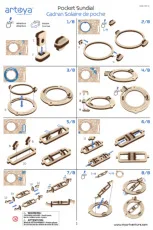
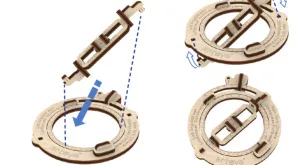
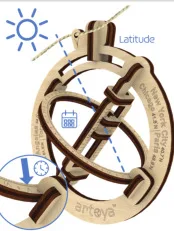
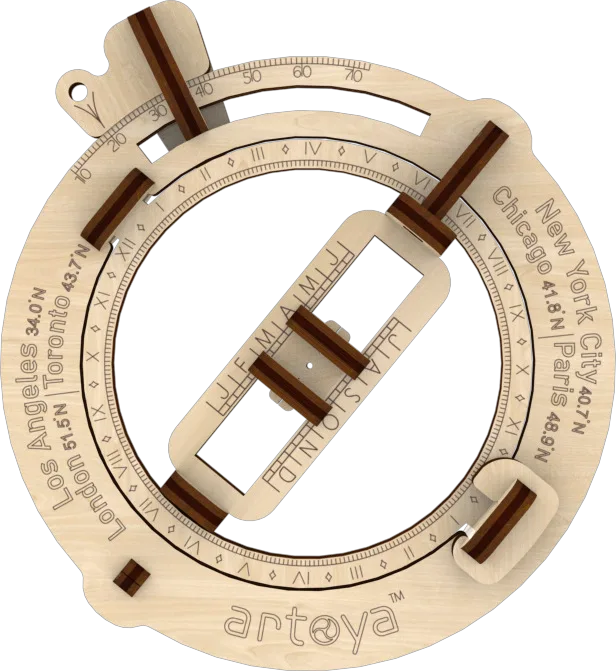
Let's be honest about what it is not. It will not give you clock time. It reads the Sun, not your time zone, and it is a replica for learning, not an instrument: built to be understood. What it gives in return is what a diagram cannot — why solar noon is not 12:00, why the gnomon angle must match your latitude, and how the Sun's height shifts with the seasons — learned by setting two cursors and watching a dot of light. Age 14+, and no two finished dials are alike.
Sources ARTOYA leaflet AV0118118 (approved copy) · ARTOYA lesson plan LESSON_AV0118118 (build order and safety note)
2How a ring dial tells the time
Most sundials work by shadow. Ours works by light, which puts it in a particular family: the equinoctial ring dial. The Science Museum in London describes one made by Richard Glynne between 1710 and 1729 in words that could be our instruction sheet: suspension ring set to the latitude, a pinhole index moved to the date on the central bridge, and the light through the pinhole marking the hour on the inner ring.
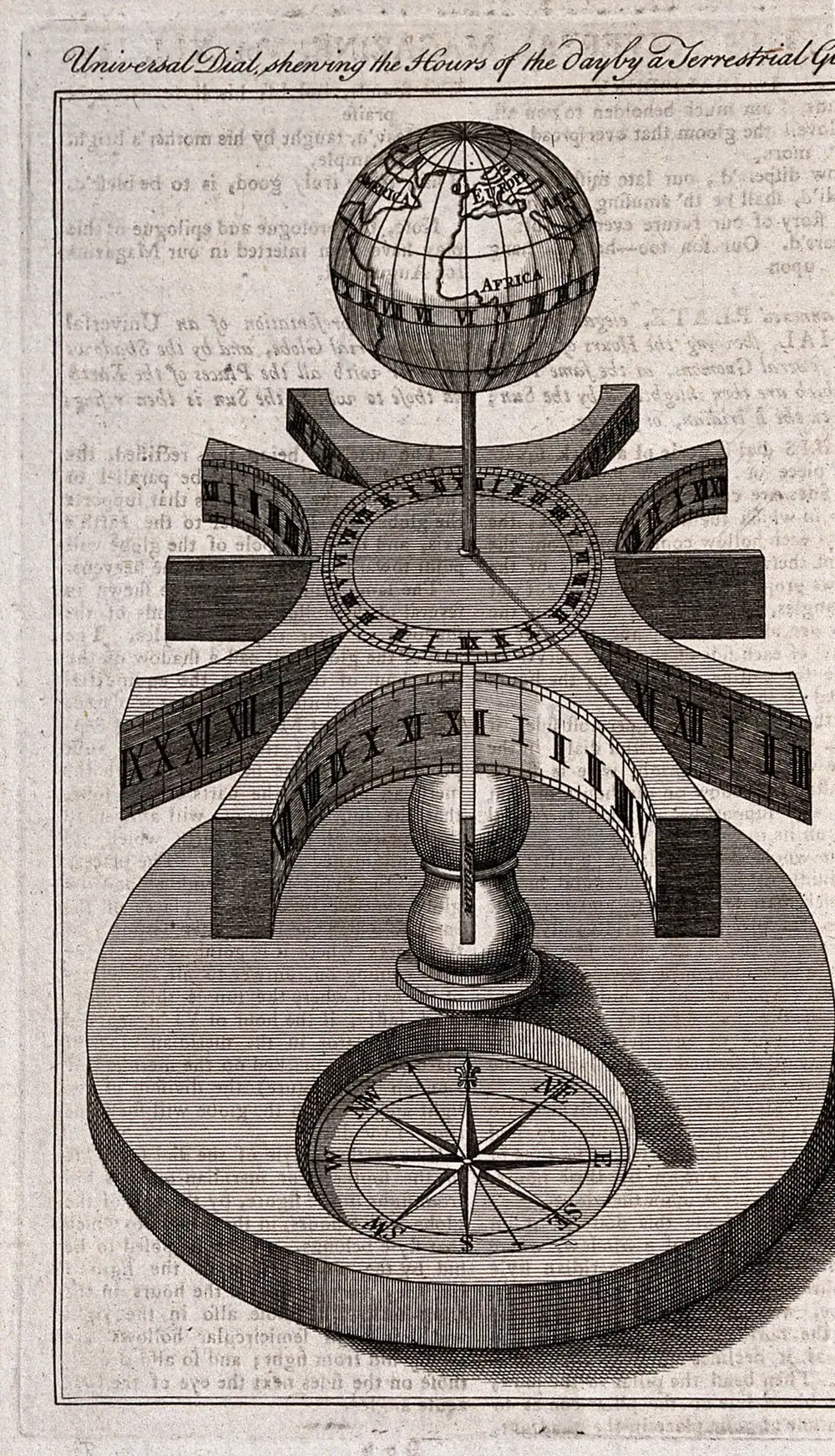
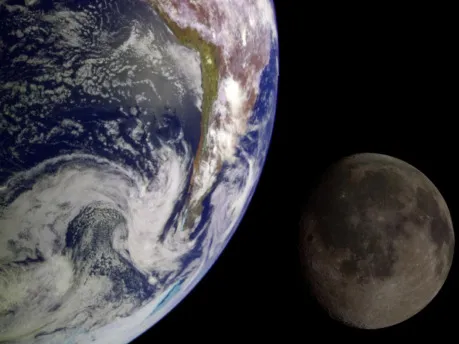
Why latitude first? Because the hour ring only reads true when it lies in the plane of Earth's equator, and the pinhole bridge only when it points along Earth's axis. Tilting the frame by your latitude puts them there — the leaflet's "built for one spot" in mechanical form, and why the dial is called universal: re-set the latitude and it works anywhere. The date cursor does the second job: the Sun stands up to 23.4° above the celestial equator in June and below it in December, so the pinhole slides along the bridge to meet it. Get both right and, as the London Museum notes of a dial signed by Thomas Tompion in 1680, the dial is self-orienting: when the spot falls on the hour ring you are aligned, no compass needed; if it misses, you are not facing the Sun.
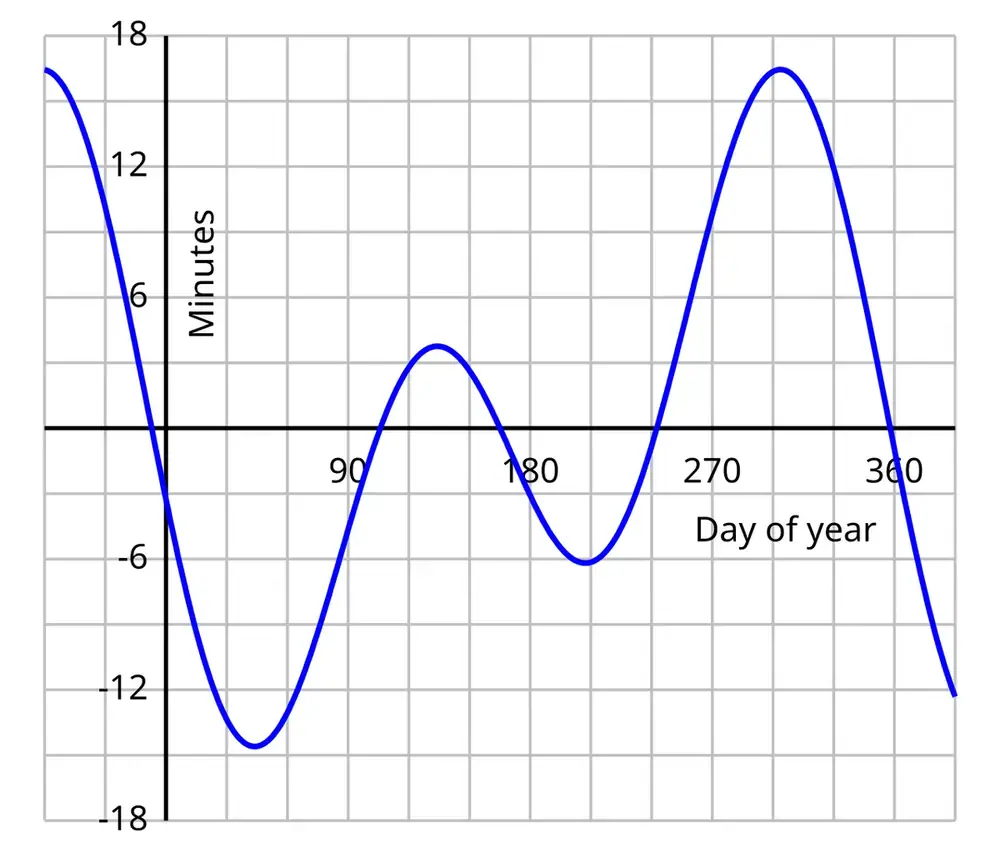
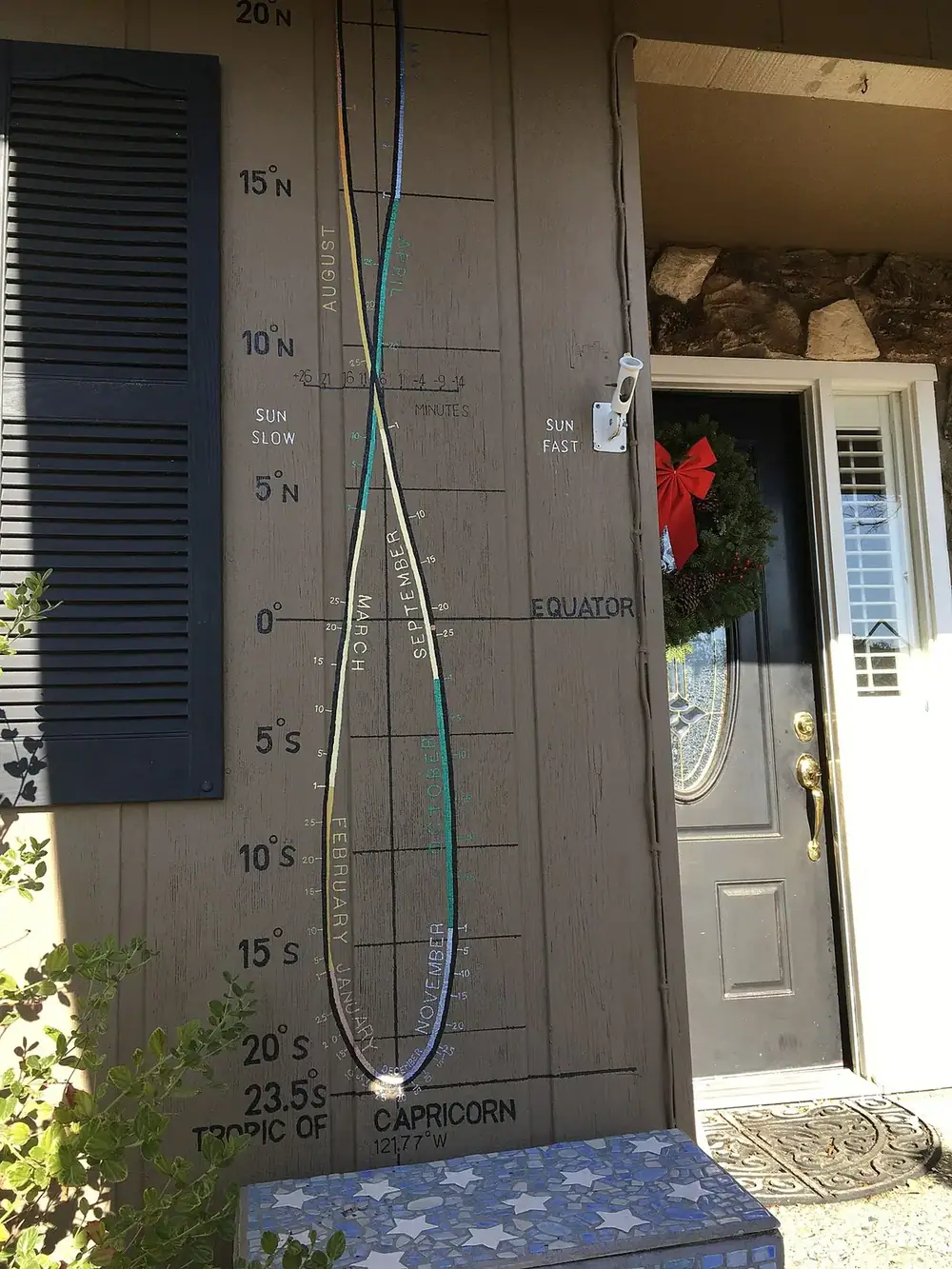
Now the disagreement. Noon on the dial is when the Sun is highest, and a clock rarely says 12:00 just then. The US Naval Observatory calls the gap the equation of time and gives it two causes: Earth's orbit is not quite a circle, so our speed along it varies, and Earth's axis is tilted. Together they put the Sun up to 16 minutes ahead of the clock or behind it — NASA's Mars24 team gives the swing as −14.2 to +16.3 minutes. Plotted against the Sun's noon height through a year, the gap traces a figure of eight, the analemma. A clock, as the leaflet says, keeps average time. The dial keeps the real thing. Look at your model: when the dot lands on a graduation, cord, latitude cursor and pinhole are all right at once.
Sources Science Museum Group Collection — collection.sciencemuseumgroup.org.uk, "Universal equinoctial ring sun dial, 1710–1729", 1927-1147 · London Museum — londonmuseum.org.uk, "Universal equinoctial ring dial", 80.271/100 · US Naval Observatory — aa.usno.navy.mil, "The Equation of Time" · NASA Goddard Institute for Space Studies — giss.nasa.gov, "Mars24 Sunclock: Technical Notes on Mars Solar Time"
3Older than almost anything in science
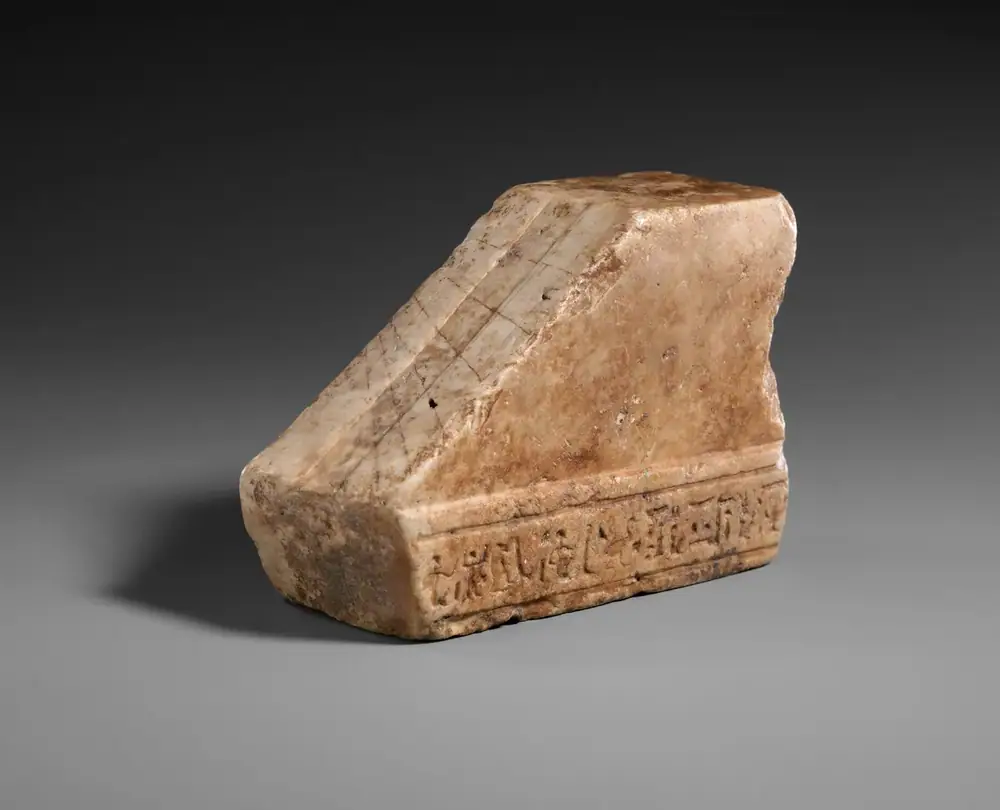
The earliest sundials are over 3,500 years old, from ancient Egypt, and the survivors are simpler than you might expect. The Science Museum holds an Egyptian shadow clock in pine, dated 1000–800 BC: a marked board and a raised bar whose shadow, the museum notes, timed labour and regulated irrigation. In 2013 a University of Basel team digging in the Valley of the Kings, Egypt, found a limestone slab about 16 cm long with a black semicircle divided into twelve — a thirteenth-century-BC sundial, probably for timing the shifts of the men cutting the royal tombs.
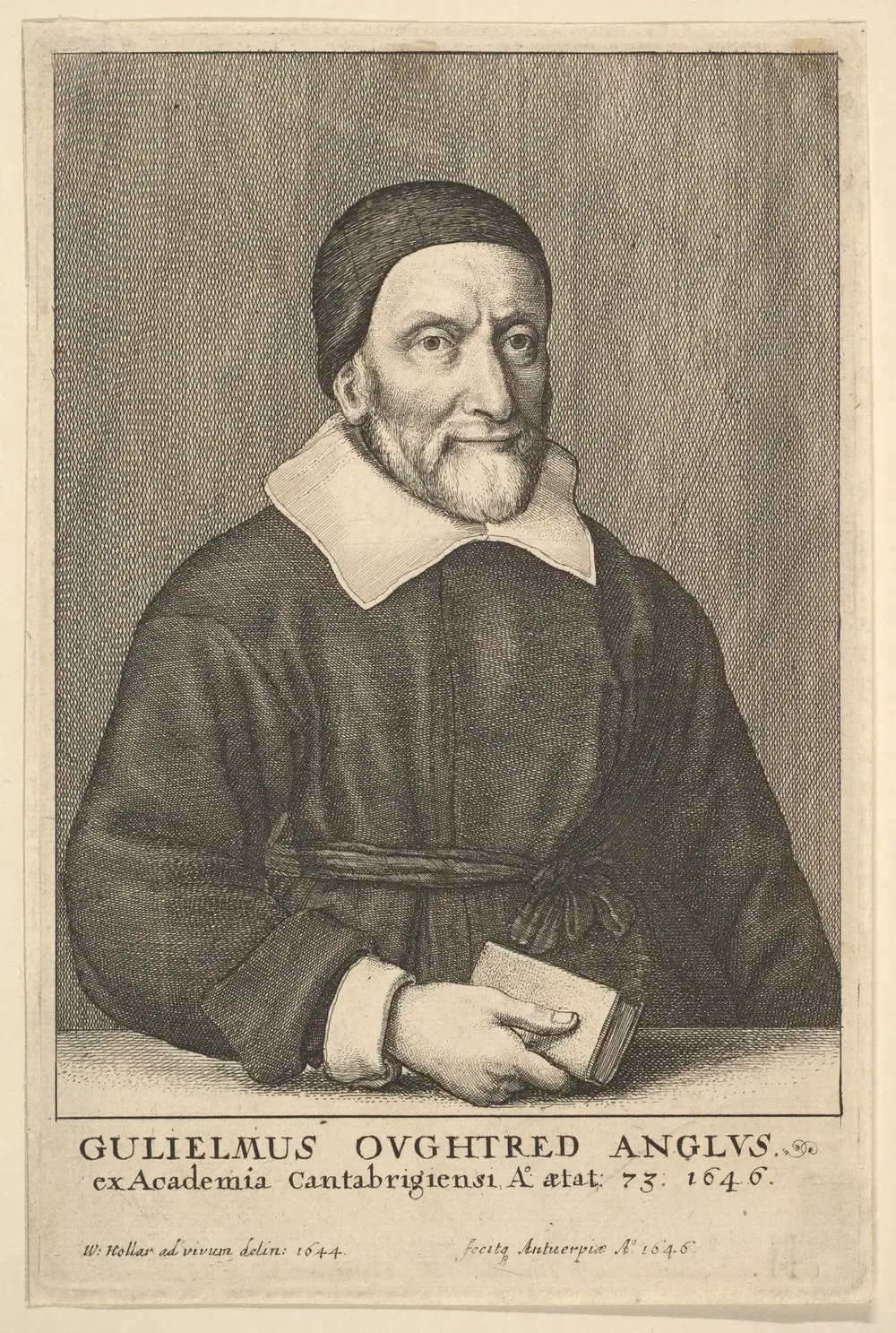
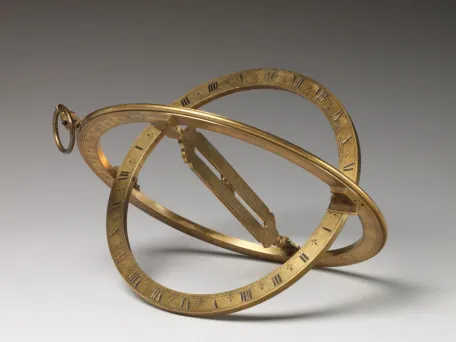
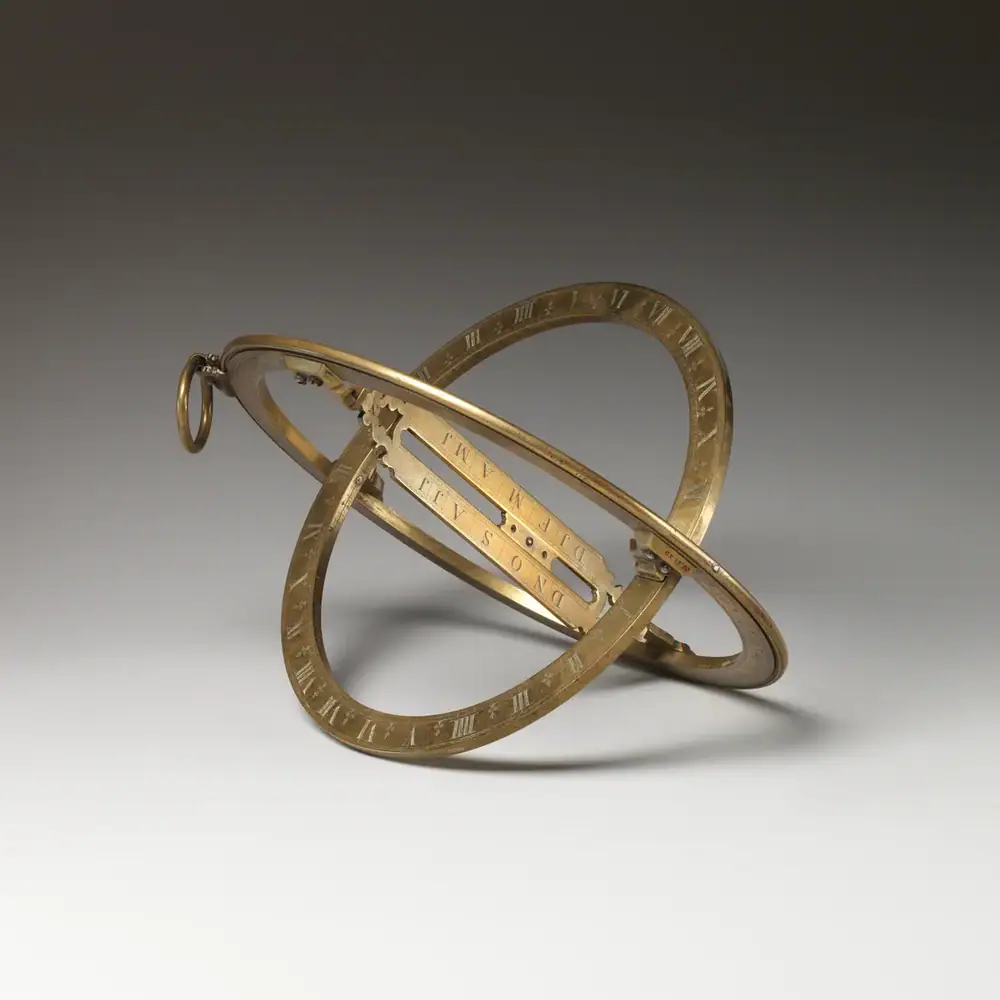
Greek, Roman, Chinese and Arab astronomers turned the shadow into a precision tool, and until pendulum clocks nothing kept time better. Our ring dial is a late chapter: Royal Museums Greenwich, England, names the mathematician William Oughtred as its designer and Elias Allen as its first maker, around 1635, and the type ran on through the eighteenth century — Jonathan Sisson's brass dial at the Met is the one on our leaflet.
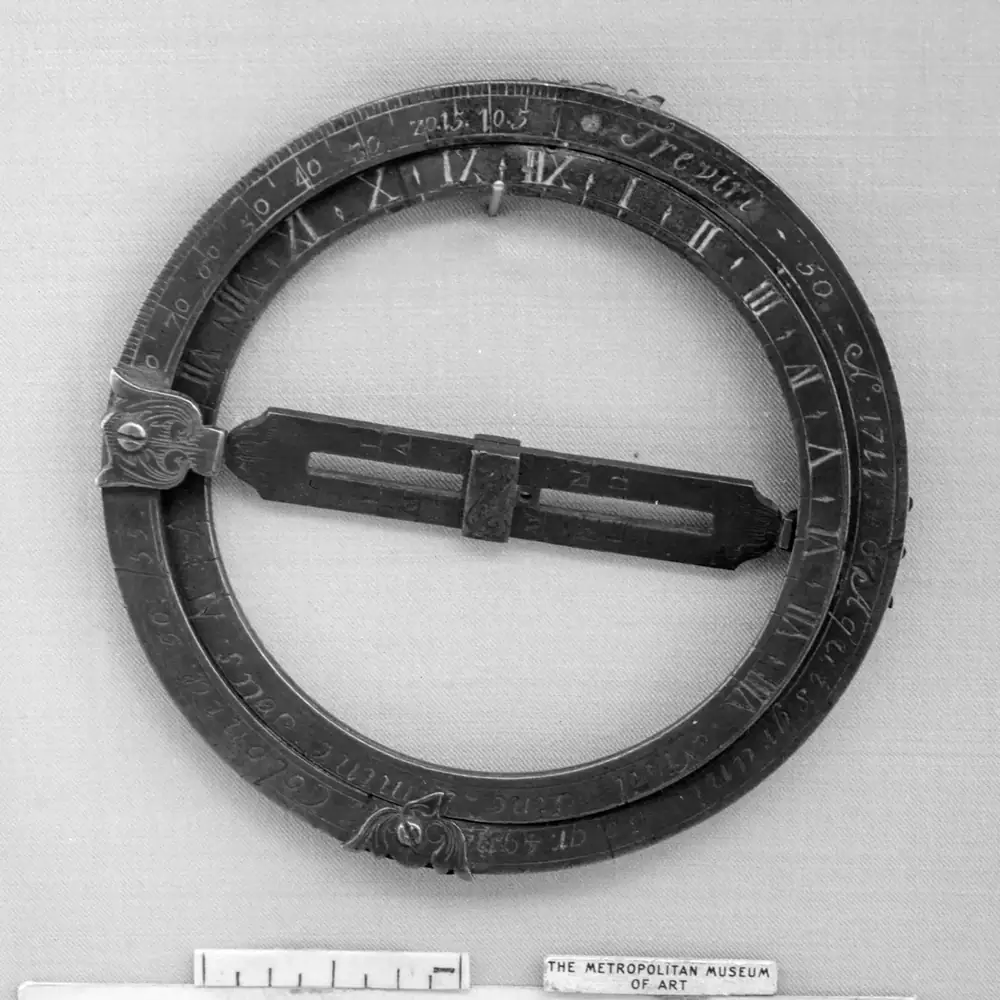
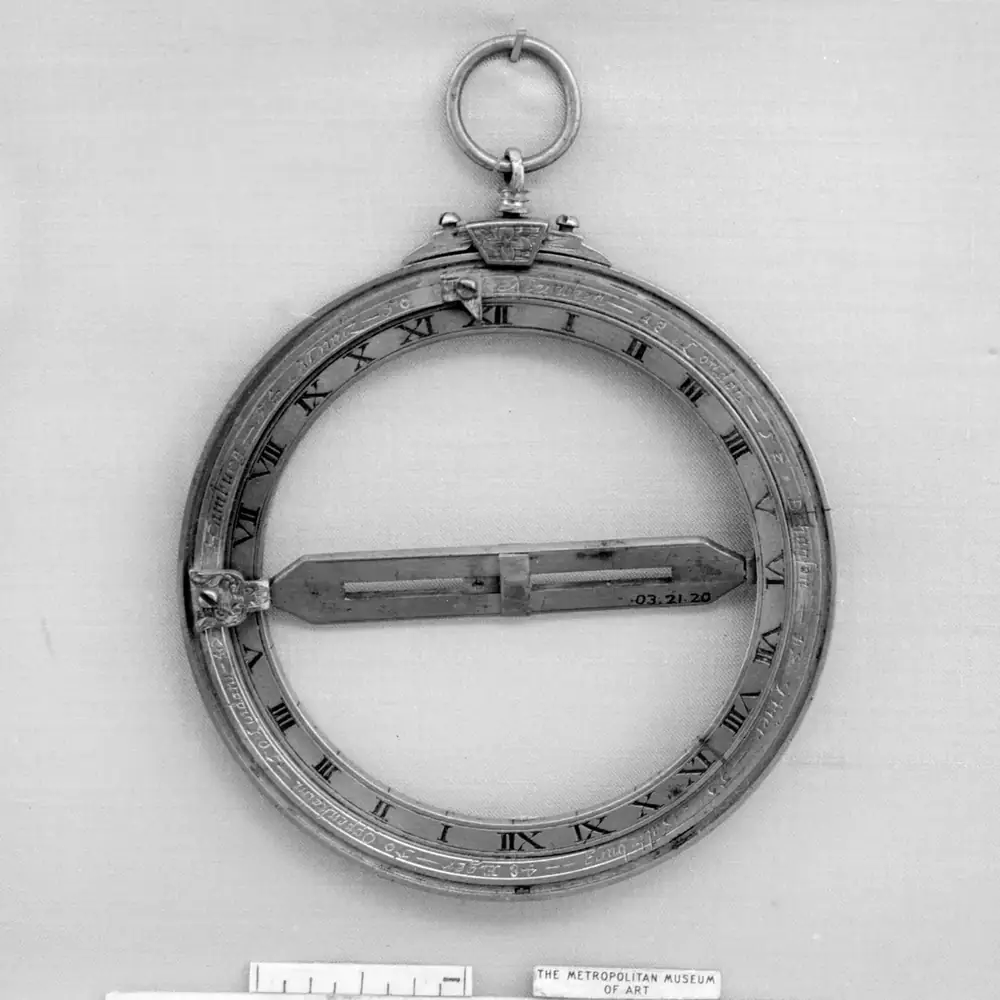
Why carry a sundial once you had a watch? Because the watch was the thing that needed checking. The Met's clock watch by Jan Jansen Bockeltz of Haarlem, in the Netherlands (about 1605–10, on our leaflet), has a sundial and compass inside its lid — "a useful addition", the museum says, "for setting and correcting the watch".
Sources Science Museum Group Collection — collection.sciencemuseumgroup.org.uk, "Ancient Egyptian altitude sundial, or shadow clock", 1926-992 · The Metropolitan Museum of Art — metmuseum.org, "Clock watch with astronomical dial and sundial", 17.190.1603 · University of Basel press release, 14 March 2013 (via ScienceDaily) · Royal Museums Greenwich — rmg.co.uk, AST0207 (Allen)
4Why the Sun seems to move
The Sun doesn't cross the sky. You turn beneath it, at 1,600 km/h at the equator, which is why the spot creeps round the ring at a steady pace: one turn of Earth, one circuit. What changes through the year is the height. Earth's 23.4° lean gives us the seasons, not our distance from the Sun — NASA's Space Place points out that we are closest to it in January. Summer is when your half of the planet leans toward the Sun.
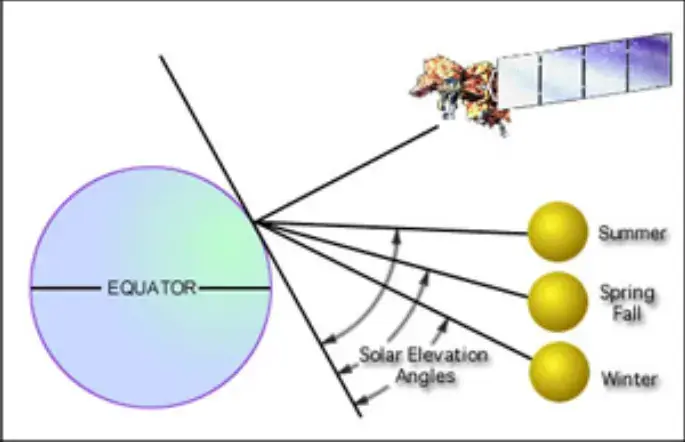
That height has a rule, and the date cursor obeys it. NASA's Goddard Space Flight Center puts it simply: at the equinoxes the noon Sun stands 90° minus your latitude above the horizon; at the solstices, the tilt higher or lower. From 40° North that is about 50° in March and September, 73° in June and 27° in December — slide the pinhole to December and you are aiming at a Sun barely a quarter of the way up the sky.
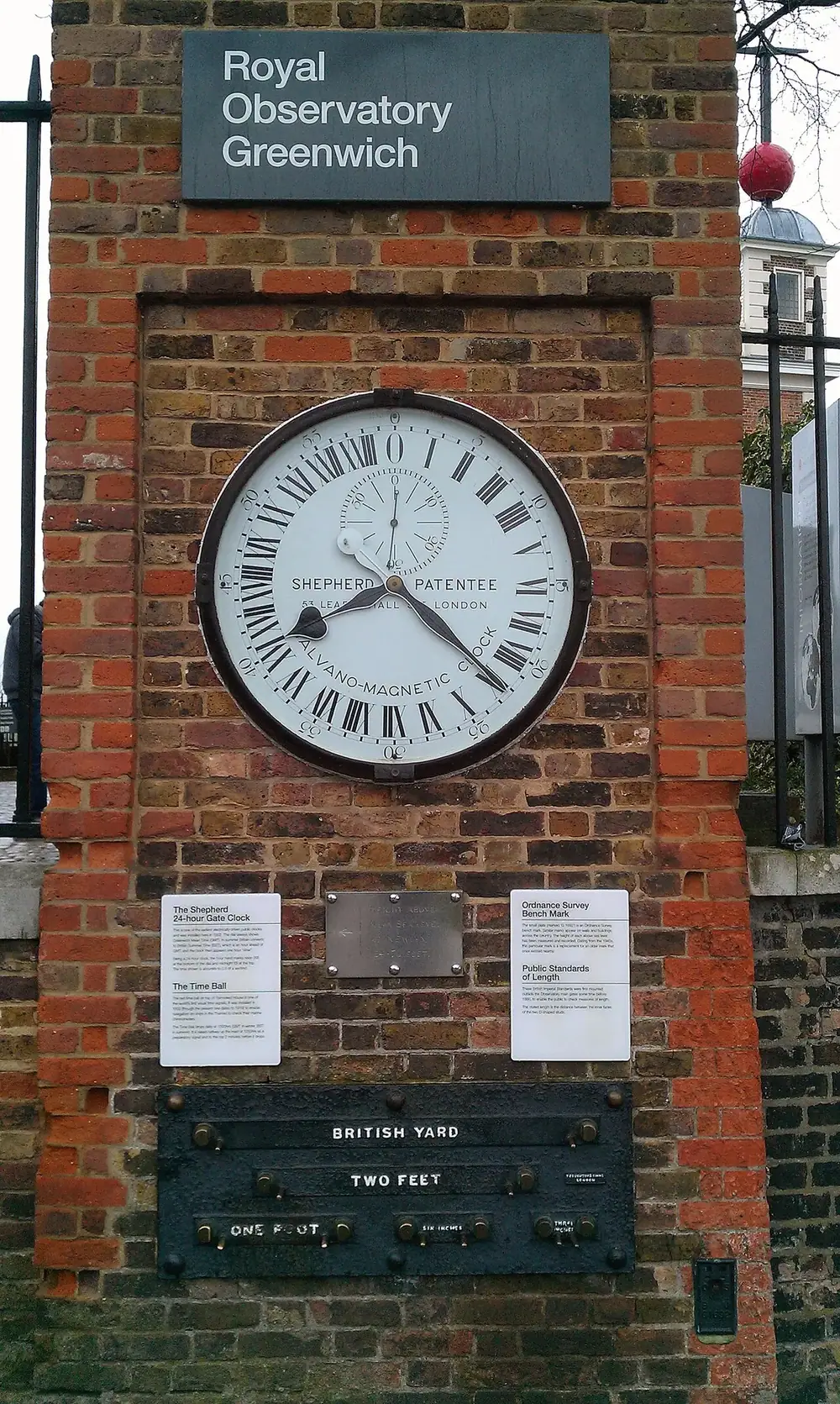
The other half of the quarrel between dial and clock is ours. Solar noon comes at a different instant along every line of longitude, and until the 1840s every British town kept its own time: Royal Museums Greenwich records Plymouth about 16½ minutes behind Greenwich. Railways could not run on that, and Greenwich Mean Time — "mean" because every clock day is made the length of the average solar day — became legal time in Great Britain in 1880. So your clock keeps the average Sun of a whole time zone; your dial keeps the actual Sun overhead. Both are right. They answer different questions.
Sources NASA Space Place — spaceplace.nasa.gov, "What Causes the Seasons?" · NASA Goddard Space Flight Center — imagine.gsfc.nasa.gov, "Ask an Astrophysicist: Earth" · Royal Museums Greenwich — rmg.co.uk, "Why do we have Greenwich Mean Time?" and "What is Greenwich Mean Time (GMT)?"
5Mottoes on the dial
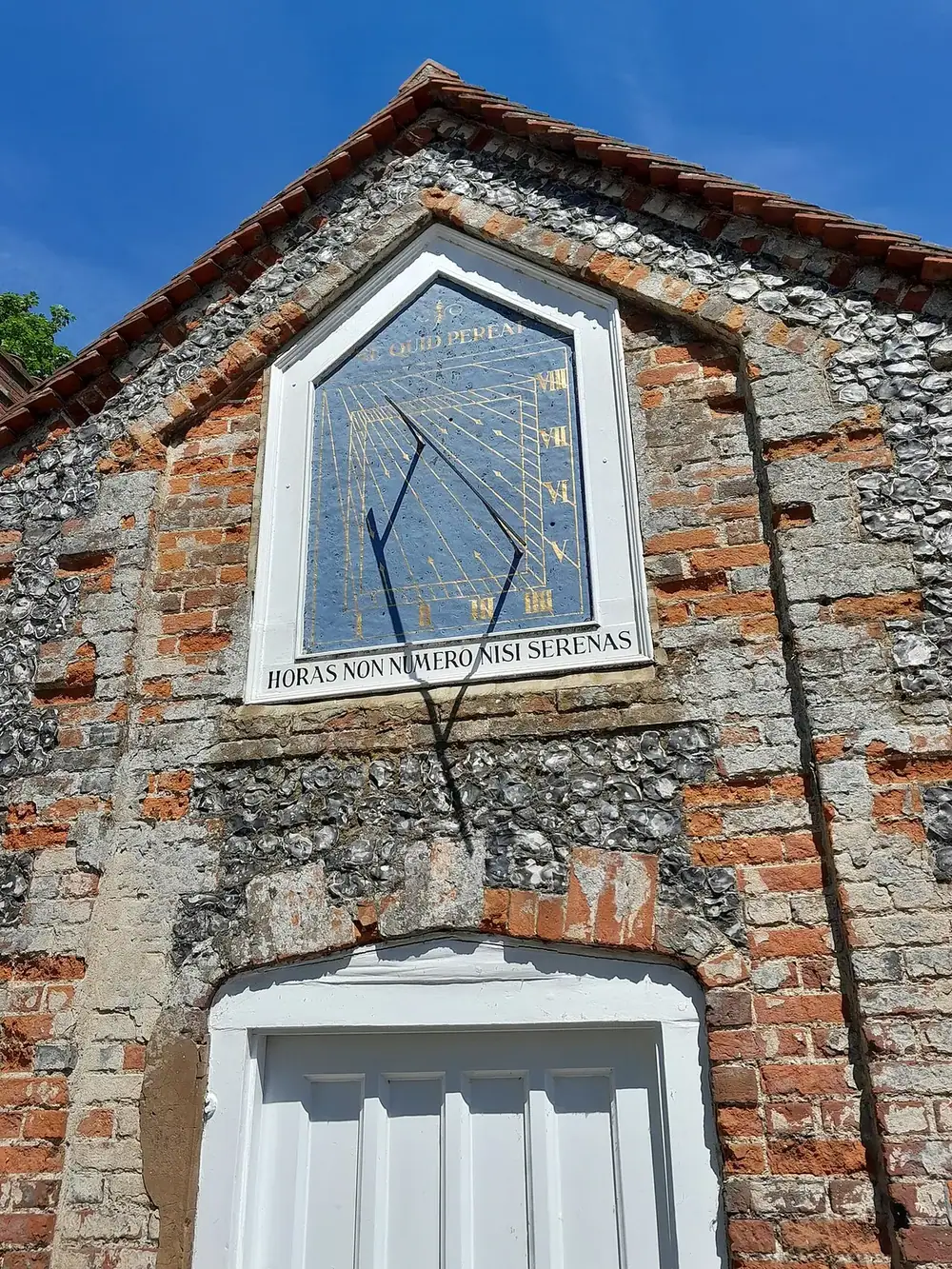
Dials were made to be looked at, and for centuries they carried carved mottoes about how little time we have. The most famous is cheerier: Horas non numero nisi serenas — "I count only the sunny hours." It is still being cut: the British Sundial Society's register records it on an 1880s dial on Dial House in Marlow, Buckinghamshire, England, paired with Ne quid pereat — "let nothing perish".
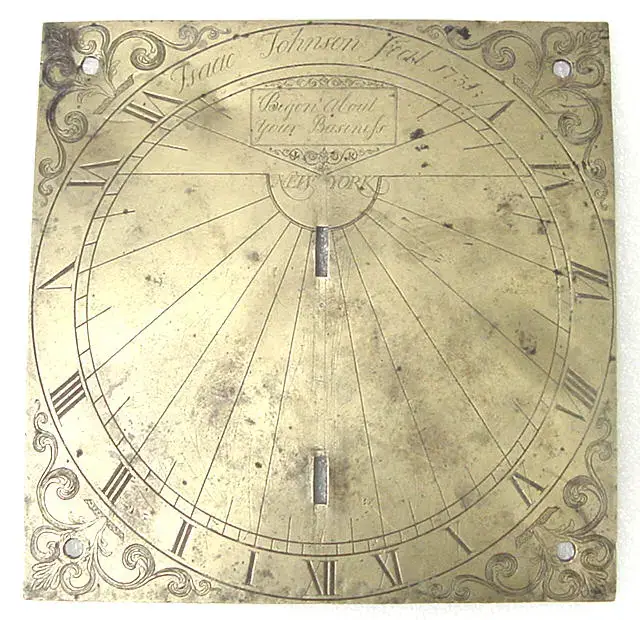
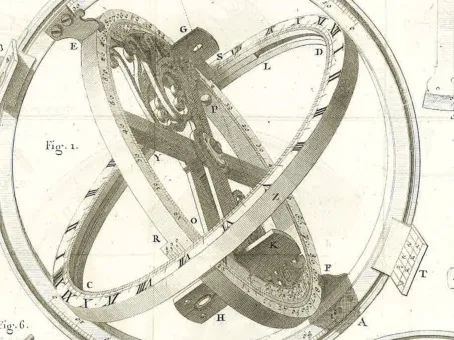
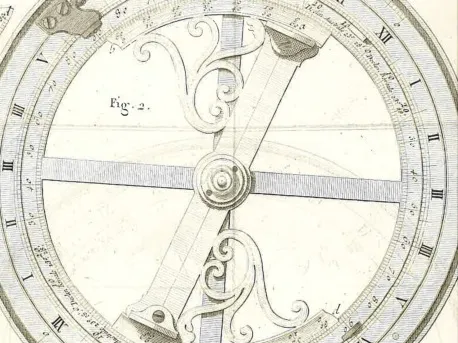
Not every motto is solemn. A brass dial in the Met's American Wing, signed "Isaac Johnson fecit 1731" and made in New York, carries the engraved instruction "Begon' about your Business" — a dial that tells you the time and then tells you to leave. Then there is the decoration around the words. The two engraved plates on our leaflet come from Dom François Bedos de Celles's La Gnomonique pratique — "practical gnomonics, or the art of drawing sundials with the greatest precision", Paris, 1790, photographed from a private copy — a ring dial and a dial face with a scrolled bridge. The science was the excuse; the object was the point.
Sources British Sundial Society — sundialsoc.org.uk, register entry "Dial House, Marlow" (S0501) · The Metropolitan Museum of Art — metmuseum.org, Isaac Johnson, "Sundial", 1731, 2003.163 · Bedos de Celles, La Gnomonique pratique, Paris 1790 (private collection)
6From courtyards to Mars

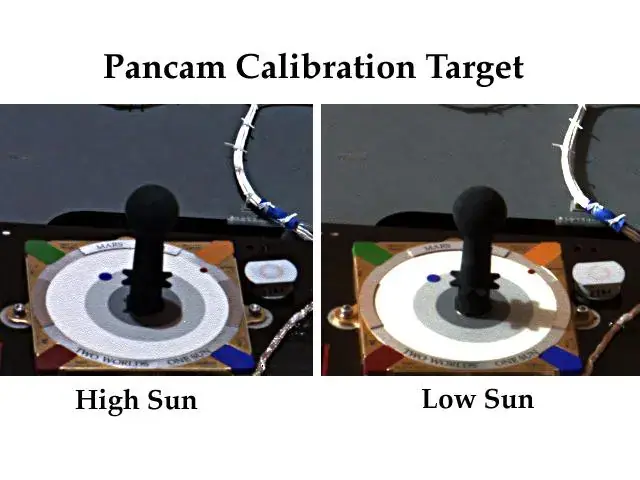
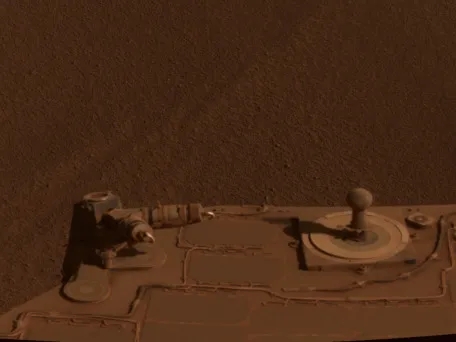
Stone and bronze, carved or forged, sundials are no longer needed for the time — which has not stopped anyone building them, on another planet included. Since 2004, NASA has sent miniature sundials to Mars aboard its rovers, to help calibrate camera colours and study sunlight on the Red Planet. NASA's Photojournal entry "Sundial Lands on Mars", dated 8 January 2004, shows the rover Spirit's panoramic camera looking down at its own MarsDial: coloured blocks in the corners to fine-tune the camera's sense of colour, a post whose shadow students followed to keep Martian time, and round the edge the word "Mars" in 17 languages. Its motto was Two Worlds, One Sun — the title of the leaflet's photograph of Opportunity's dial, taken on 2 May 2010.

A dial on Mars keeps a different kind of time. A Martian solar day — a sol — is 24 hours 39 minutes and 35 seconds, and because Mars's orbit is far more stretched than ours, its equation of time swings between −51.1 and +39.9 minutes, against Earth's −14.2 to +16.3. A Martian sundial "lies" three times more than ours, and is still telling the truth. From ancient courtyards to Mars rovers, the same sunlight still tells us where we are in time.
Sources NASA Photojournal — science.nasa.gov/photojournal, "Sundial Lands on Mars", PIA05018, and "Two Worlds, One Sun", PIA13104 · NASA Goddard Institute for Space Studies — giss.nasa.gov, "Mars24 Sunclock: Technical Notes"
7Try this
Catch solar noon. On a clear day, hang the dial from about 11:30 by the clock and note the clock time when the spot crosses the noon line. What to notice: it is almost never 12:00. Part of the gap is where you stand inside your time zone; part is the equation of time. Repeat a month later — you are tracing the analemma one point at a time.
Set the cursor for the wrong city. Read the dial correctly once, then move the latitude cursor 10° further north and read again. What to notice: the spot lands off the ring or in the wrong place. A dial really is built for one spot; a "universal" dial only earns the name because you can re-set it.
Give it a motto. Write a line of your own on the rim in ink, not acrylic — paint in the slots stops the pieces moving. What to notice: a motto you can only read in sunlight reads differently from one on a wall.
Sources US Naval Observatory — aa.usno.navy.mil, "The Equation of Time" · ARTOYA lesson plan LESSON_AV0118118 (outdoor reading; ink, not acrylic)
8Words to know
- Gnomon — the part that casts the shadow or, on a ring dial, the pinhole that admits the light; its angle must match your latitude.
- Equinoctial ring dial — a dial whose hour ring lies in the plane of Earth's equator; "universal" when it can be re-set for any latitude.
- Latitude — your distance north or south of the equator, in degrees; it fixes how high the noon Sun climbs.
- Declination — how far the Sun stands above or below the celestial equator on a given date, up to 23.4°; what the date cursor corrects for.
- Solar noon — the moment the Sun is highest in your sky; rarely your clock's 12:00.
- Equation of time — the gap between sundial time and mean (clock) time on a given date; up to about 16 minutes on Earth.
- Analemma — the figure of eight made by plotting that gap against the Sun's noon height through a year.
- Sol — a solar day on Mars, 24 hours 39 minutes and 35 seconds.
- Gnomonics — the science of sundials. Yes, it has a name.
Sources US Naval Observatory — aa.usno.navy.mil, "The Equation of Time" · Royal Museums Greenwich — rmg.co.uk, "What is Greenwich Mean Time (GMT)?" · Science Museum Group Collection — collection.sciencemuseumgroup.org.uk, 1927-1147 · NASA GISS — giss.nasa.gov, "Mars24 Sunclock"
9Sources
- Science Museum Group Collection — "Universal equinoctial ring sun dial, 1710–1729. With case", Richard Glynne, 1927-1147: https://collection.sciencemuseumgroup.org.uk/objects/co2306/universal-equinoctial-ring-sun-dial-1710-1729-with-case
- Science Museum Group Collection — "Ancient Egyptian altitude sundial, or shadow clock, in pine (wood)", 1000–800 BC, 1926-992: https://collection.sciencemuseumgroup.org.uk/objects/co473/ancient-egyptian-altitude-sundial-or-shadow-clock-in-pine-wood-sundial
- London Museum — "Universal equinoctial ring dial", Thomas Tompion (signed), 1680, 80.271/100: https://www.londonmuseum.org.uk/collections/v/object-110248/universal-equinoctial-ring-dial/
- Royal Museums Greenwich — "Universal equinoctial ring dial", Elias Allen, c. 1635, AST0207: https://www.rmg.co.uk/collections/objects/rmgc-object-10369
- Royal Museums Greenwich — "Why do we have Greenwich Mean Time? 'Local' time and the Railways": https://www.rmg.co.uk/stories/time/time-greenwich-mean-time-confusing-case-travellers-watch
- Royal Museums Greenwich — "What is Greenwich Mean Time (GMT) — and why does it matter?": https://www.rmg.co.uk/stories/time/greenwich-mean-time-gmt
- Royal Museums Greenwich — "The Greenwich Time Ball": https://www.rmg.co.uk/royal-observatory/attractions/greenwich-time-ball
- Royal Museums Greenwich — "The Greenwich Time Ball and one time for all": https://www.rmg.co.uk/stories/time/greenwich-time-ball-one-time-all
- UNESCO World Heritage Centre — "The Jantar Mantar, Jaipur", World Heritage List 1338 (inscribed 2010): https://whc.unesco.org/en/list/1338/
- UNESCO World Heritage Centre / ICOMOS — Advisory Body Evaluation, "Jantar Mantar (India), No 1338", 2010 (Vrihat Samrat Yantra: height 22.6 m incl. 3.5 m below ground, hypotenuse 50.1 m, precision 2 seconds): https://whc.unesco.org/document/152416
- The Metropolitan Museum of Art — "Universal ring sundial", Jonathan Sisson, 18th century, 03.21.7: https://www.metmuseum.org/art/collection/search/188835
- The Metropolitan Museum of Art — "Clock watch with astronomical dial and sundial", Jan Jansen Bockeltz, c. 1605–10, 17.190.1603: https://www.metmuseum.org/art/collection/search/194191
- The Metropolitan Museum of Art — "Shadow Clock", Ptolemaic Period, 305–30 BC, 12.181.307: https://www.metmuseum.org/art/collection/search/576278
- The Metropolitan Museum of Art — "Sundial", Isaac Johnson, New York, 1731, 2003.163: https://www.metmuseum.org/art/collection/search/17560
- University of Basel — press release "One of world's oldest sun dial dug up in Kings' Valley, Upper Egypt", 14 March 2013, as reproduced by ScienceDaily: https://www.sciencedaily.com/releases/2013/03/130314085052.htm
- US Naval Observatory, Astronomical Applications Department — "The Equation of Time" (causes, 23.4° obliquity, the analemma): https://aa.usno.navy.mil/faq/eqtime
- NASA Goddard Institute for Space Studies — "Mars24 Sunclock: Technical Notes on Mars Solar Time": https://www.giss.nasa.gov/tools/mars24/help/notes.html
- NASA Goddard Space Flight Center, Imagine the Universe — "Ask an Astrophysicist: Earth": https://imagine.gsfc.nasa.gov/ask_astro/earth.html
- NASA Space Place — "What Causes the Seasons?": https://spaceplace.nasa.gov/seasons/en/
- NASA Space Place — "All About the Sun" (light takes about 8 minutes 20 seconds to reach Earth): https://spaceplace.nasa.gov/all-about-the-sun/en/
- NASA Science — "Sun: Facts" (about 150 million km from Earth): https://science.nasa.gov/sun/facts/
- NASA Photojournal — "Sundial Lands on Mars", PIA05018, 8 January 2004: https://science.nasa.gov/photojournal/sundial-lands-on-mars/
- NASA Photojournal — "Two Worlds, One Sun", PIA13104, 6 May 2010: https://science.nasa.gov/photojournal/two-worlds-one-sun/
- NASA Image and Video Library — "Amazing Hi-Def CME [full disk]", SDO, 16 April 2012, GSFC_20171208_Archive_e001770: https://images.nasa.gov/details/GSFC_20171208_Archive_e001770
- U.S. Geological Survey — "Earth's Axial Tilt and Seasonal Effects" (public domain): https://www.usgs.gov/media/images/earths-axial-tilt-and-seasonal-effects
- Library of Congress, Prints and Photographs Division — "Jeypore. Jey Sing's Observatory", photochrom, Photoglob Company, c. 1890–1910, LC-DIG-ppmsca-41461: https://www.loc.gov/item/2017657616/
- Wellcome Collection — "Clocks: a universal sundial, with a compass. Engraving", 45214i: https://wellcomecollection.org/works/cpyrw6ej
- Wellcome Collection — "London, seen from beside Flamsteed House in Greenwich park. Lithograph by T. S. Boys after himself, 1842", 34476i: https://wellcomecollection.org/works/nv2jrz6t
- British Sundial Society — register entry "Dial House, Marlow" (S0501): https://sundialsoc.org.uk/wp_bridol/pages/S0/S0501.html
- ARTOYA leaflet AV0118118 (approved EN copy, printed 21 Sep 2026) and its printed sources: Encyclopaedia Britannica "sundial"; British Sundial Society; North American Sundial Society; NASA Science "Sun"; K. R. Lang, The Cambridge Guide to the Solar System; Smithsonian National Air and Space Museum; NASA/JPL-Caltech/Cornell University Photojournal PIA13104 and PIA05018; Bedos de Celles, La Gnomonique pratique, Paris 1790.
ARTOYA Education Platform · artoya.co/pocket-sundial · Download the leaflet and the lesson plan at myartventure.com/a/AV0118118 · [email protected]