The five solids: a complete set, and a proof you can hold
Count the faces that meet at one corner of each model and you are doing, with your hands, the proof Euclid wrote 2 300 years ago. Five open frames in plywood — and then a Greek oracle die, a Roman puzzle nobody has solved, a dome in Montreal and a universe shaped like a football.
Build the five ARTOYA solids and you build the whole list: every regular convex solid there is. We count corners with Euclid, watch Leonardo draw them hollow for Pacioli, find them in salt, diamond and virus shells, and follow Kepler's beautiful wrong idea.
« Having seen it is not as good as knowing it; knowing it is not as good as doing it. » — Xunzi, 3rd century BC
1What you are building
The ARTOYA Solids set is five models in one box — tetrahedron, hexahedron, octahedron, dodecahedron and icosahedron (the Greek names count the faces: the hexahedron, six squares, is the cube you already know) — 83 pieces of birch plywood, cut and marked on their boards. Allow about two hours, in the order the sheet in the box gives: check that every piece is on the board; press each one out only when the sheet calls for it; build the smallest first — for the tetrahedron, a disc and three uprights make the core, then four faces; work up through hexahedron, octahedron, dodecahedron and icosahedron, frame first, then faces; paint last, or keep them plain. Once built, they stay built.
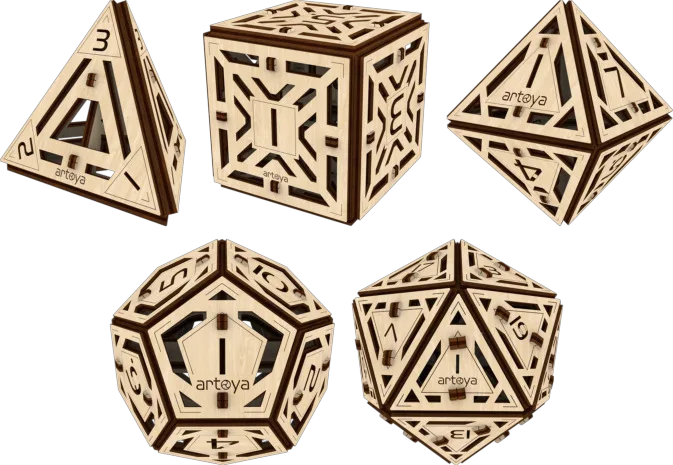
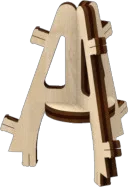
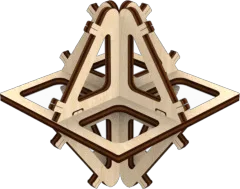
They are not precision dice. They work as dice — a little big for the table — and the small connectors keep them from lying perfectly flat. First they are geometric models, built to show the shapes: built to be understood. What they give is faces, edges and vertices we can count on our fingers; the reason exactly five regular solids can exist and no more; and a look at how an open frame reveals what holds it up. And no two finished sets are alike.
Sources ARTOYA leaflet AV0118106 (EN copy as printed, 21 Sep 2026) · Encyclopaedia Britannica — britannica.com, "Platonic solid"
2Why exactly five
A regular solid is a strict thing: every face the same regular polygon, every corner the same. The leaflet gives the whole argument in one instruction — count the faces meeting at one corner — and here is why it works.
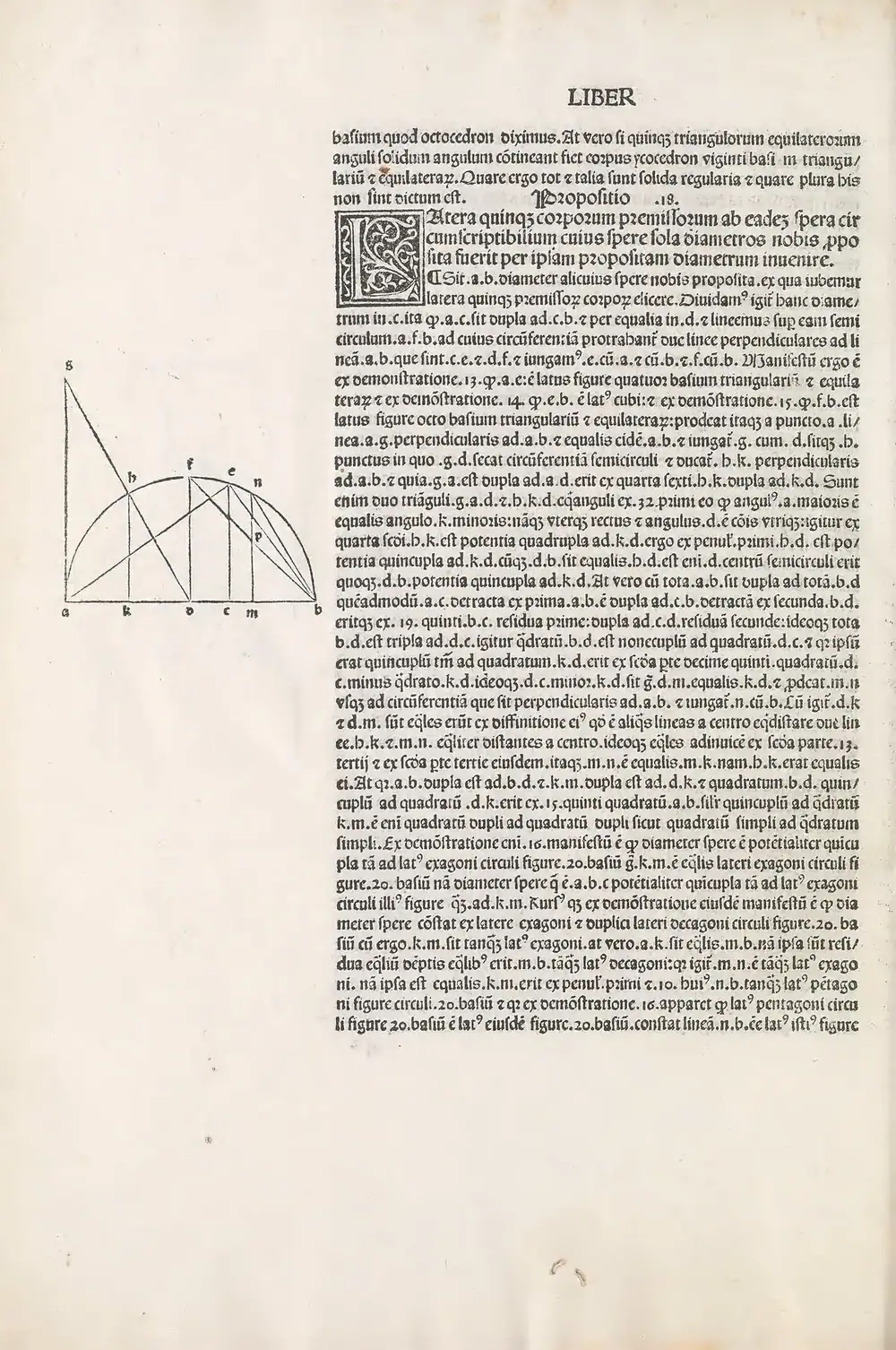
At any corner at least three faces meet; two would fold flat like a book. And their angles, added up around the corner, must come to less than 360°: at exactly 360° the faces lie flat, past it they overlap. That is the rule Euclid states in the remark closing the Elements: the plane angles at a solid angle add up to less than four right angles. Equilateral triangles have 60° corners: three make the tetrahedron, four the octahedron, five the icosahedron; six make 360° and lie flat. Squares, 90°: three make the hexahedron, four lie flat. Pentagons, 108°: three make the dodecahedron, four overlap. Hexagons, 120°: three already make 360° — a honeycomb, never a corner. Three plus one plus one: five, and nowhere left to look.
Once the five stand, count them. Each obeys the rule Leonhard Euler sent to Christian Goldbach in a letter of 1750: vertices minus edges plus faces equals two.
| Solid | Face shape | Faces at a corner | Angles at a corner | Vertices (V) | Edges (E) | Faces (F) | V − E + F |
|---|---|---|---|---|---|---|---|
| Tetrahedron | triangle | 3 | 180° | 4 | 6 | 4 | 2 |
| Hexahedron | square | 3 | 270° | 8 | 12 | 6 | 2 |
| Octahedron | triangle | 4 | 240° | 6 | 12 | 8 | 2 |
| Dodecahedron | pentagon | 3 | 324° | 20 | 30 | 12 | 2 |
| Icosahedron | triangle | 5 | 300° | 12 | 30 | 20 | 2 |
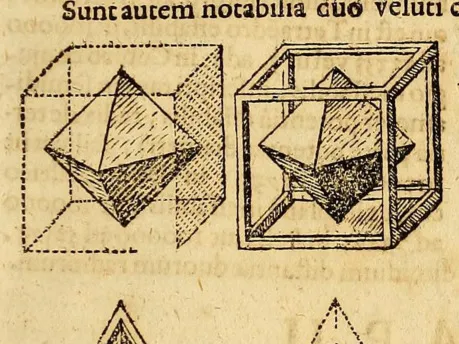
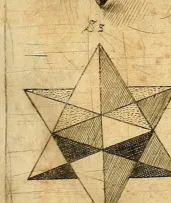
Hexahedron and octahedron swap their V and F, and so do dodecahedron and icosahedron: join the face centres of your hexahedron and you have drawn an octahedron inside it. The tetrahedron is its own partner.
Sources Euclid, Elements, Book XIII, Proposition 18 and the remark following it — Clark University, D. E. Joyce edition, mathcs.clarku.edu · American Mathematical Society — ams.org, "Euler's Polyhedral Formula" · ARTOYA leaflet AV0118106
3Plato, Euclid — and a twenty-sided oracle
The five carry Plato's name because of one book. In the Timaeus, written in Athens, Greece, around 360 BC, the world is built from four elements and each gets a body: the tetrahedron for fire, the hexahedron for earth, the octahedron for air, the icosahedron for water. That leaves one solid and no element, so the dodecahedron is "used for the universe as a whole".
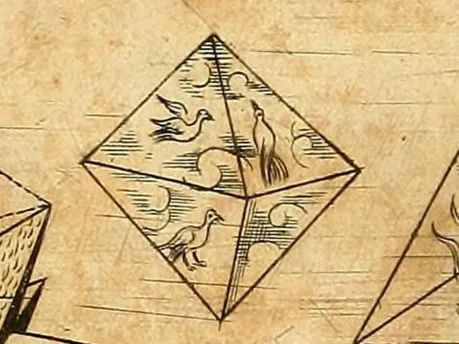
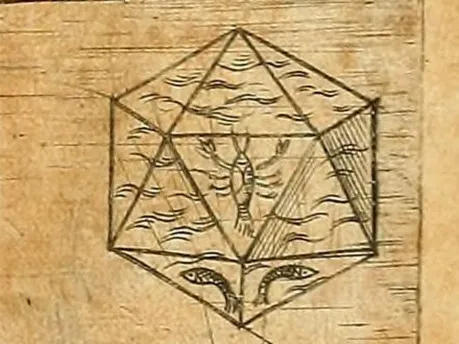
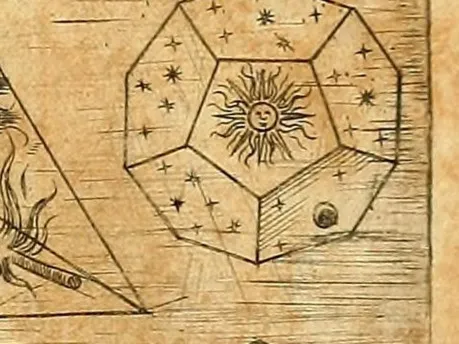
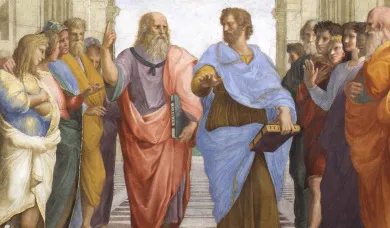
The mathematics came from Plato's circle, and Euclid, in Alexandria, Egypt, around 300 BC, settled it for good. The last proposition of the last book, XIII.18, constructs the edges of all five in one sphere and compares them in a single figure; the remark that follows is the corner-counting proof of section 2.
Sources Stanford Encyclopedia of Philosophy — plato.stanford.edu, "Plato's Timaeus" · Encyclopaedia Britannica — britannica.com, "Platonic solid", "Euclid" and "Dungeons & Dragons" · Euclid, Elements, Book XIII — Clark University, mathcs.clarku.edu · Smithsonian Libraries, Preclarissimus liber elementorum Euclidis (Venice, 1482) — archive.org · The Metropolitan Museum of Art — metmuseum.org, 10.130.1158 and 37.11.3
4Leonardo's hollow solids — and a Roman puzzle
In Milan, Italy, Leonardo drew sixty solids in watercolour for the mathematician Luca Pacioli's De divina proportione, each hanging from a ribbon with its Latin name. The manuscript is dated 14 December 1498; the book was printed in Venice, Italy, on 1 June 1509 with the drawings cut as woodcuts. The ribbons tell you what you are looking at: planum is plain, solidum solid, vacuum emptied — the frame alone. "Duodecedron planum vacuum" is the dodecahedron drawn hollow, every edge a strut and the far side showing through: the first time anyone had illustrated solids that way, and the reason your models are open frames. Build the dodecahedron, hold it beside the plate, and you have made the drawing.
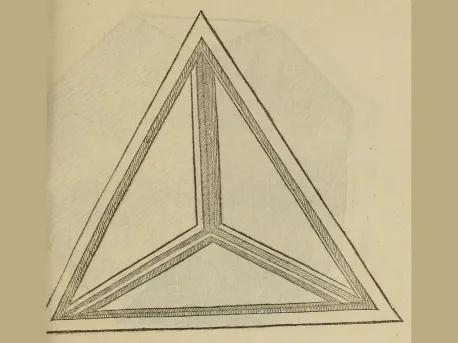
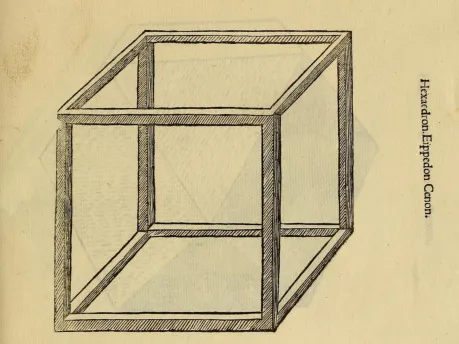
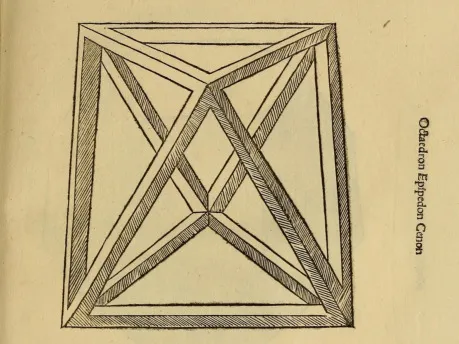
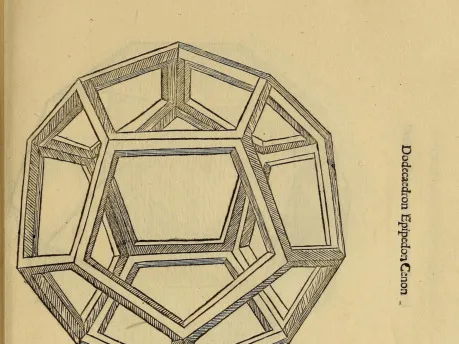
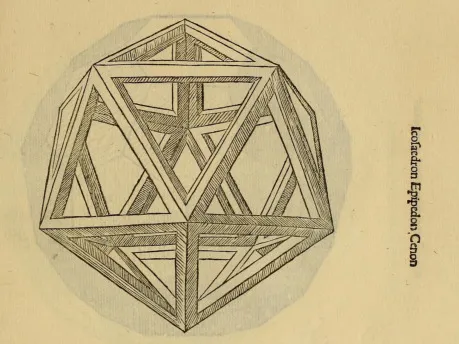
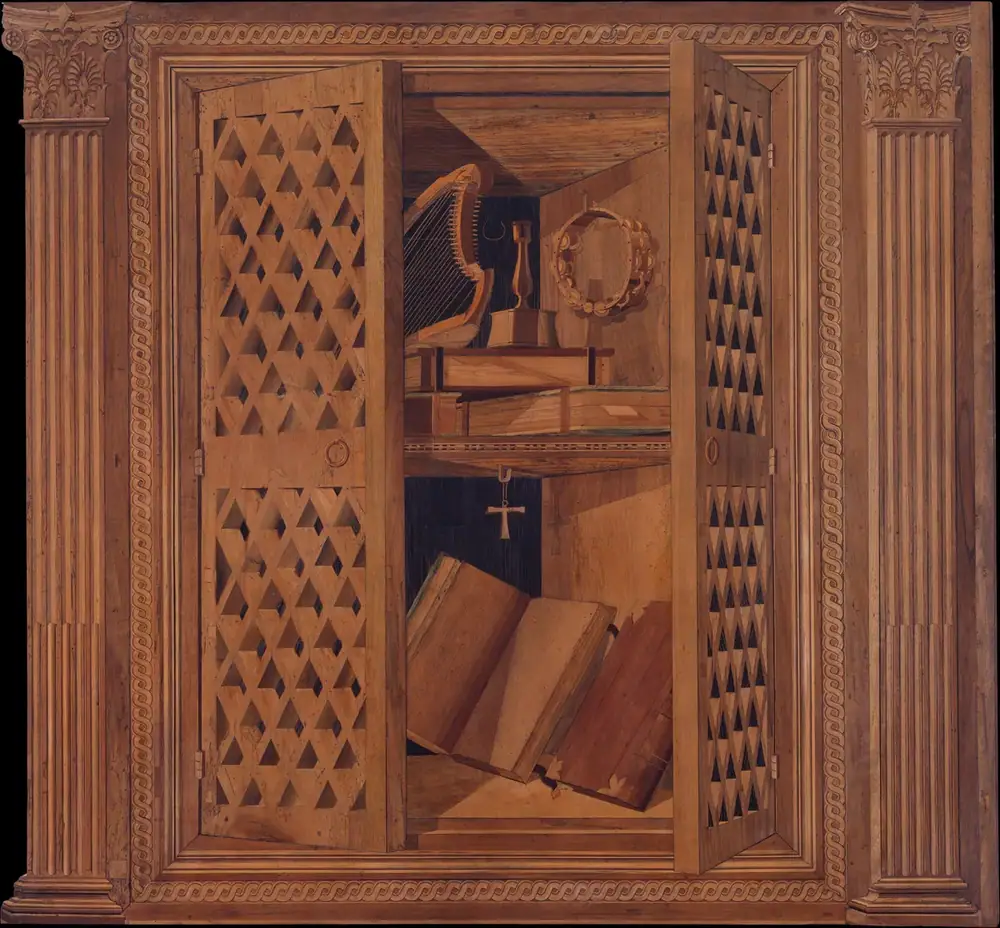
Woodworkers were earlier. The studiolo from the ducal palace at Gubbio, Italy, of about 1478–82, is now at the Met (39.153): a small room panelled in intarsia, veneer cut and fitted to show cupboards, books and a polyhedral ring on a peg — all in perspective, all flat.
Sources Biblioteca Ambrosiana — ambrosiana.it, "De divina proportione" · The Metropolitan Museum of Art — metmuseum.org, Divina proportione (19.50) and Studiolo from the Ducal Palace in Gubbio (39.153) · Biblioteca de la Universidad de Sevilla, Diuina proportione (Venice, 1509) — archive.org · Lincolnshire County Council — lincolnshire.gov.uk, "Mysterious Roman dodecahedron found in Norton Disney" · The British Museum — britishmuseum.org, 1924,0411.1
5Nature's identical parts — and Fuller's dome
Plato was wrong about the why — there are no tiny tetrahedra of fire — and strangely right about the where: when nature repeats one identical part over and over, the five keep turning up.
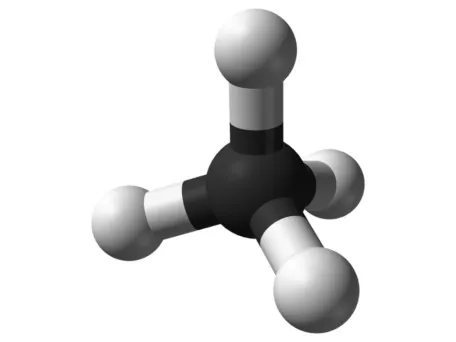
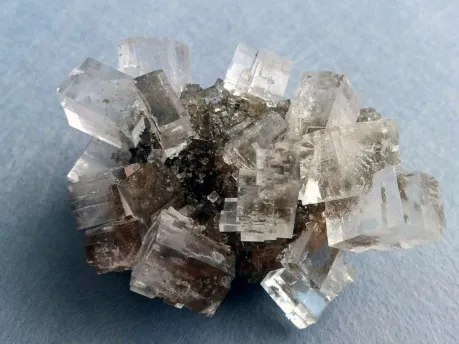
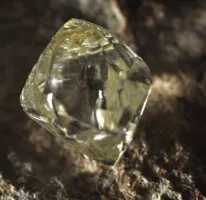
A molecule of methane is one carbon atom with four hydrogens at the corners of a regular tetrahedron, 109.5° apart — your first model. Halite, the mineral name for table salt, grows as transparent cubes and cleaves into cubes: rock salt breaks into smaller and smaller blocks. Diamond shares its crystal system but grows as the octahedron — "two pyramids back to back", says the Gemological Institute of America. Your third model, in carbon.
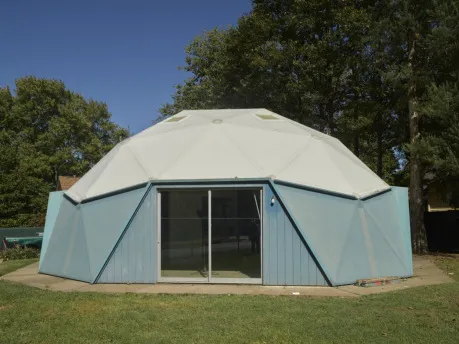
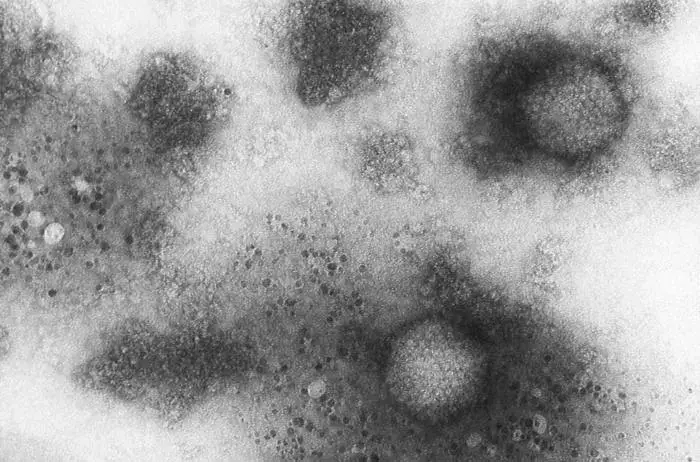
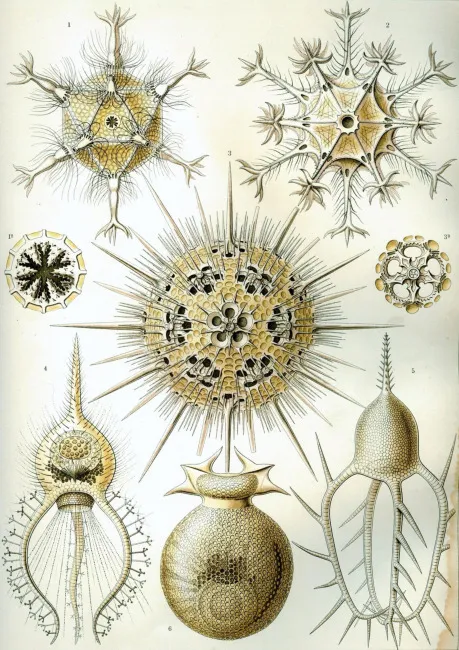
The icosahedron belongs to the living. Many viruses, adenoviruses among them, keep their genes inside a protein shell built, Britannica says, "like a geodesic dome" from twenty triangles, with the same five-fold, three-fold and two-fold axes as your model. Larger are the radiolaria, single-celled ocean organisms with minute glassy skeletons: the first plate of Ernst Haeckel's Kunstformen der Natur (1904) opens with Circogonia icosahedra — a living icosahedron.

Sources Encyclopaedia Britannica — britannica.com, "methane", "halide mineral", "isometric system", "virus: the protein capsid", "radiolarian", "geodesic dome" and "R. Buckminster Fuller" · Gemological Institute of America — gia.edu, "Diamond description" · CDC Public Health Image Library — phil.cdc.gov, ID 14768 · Ernst Haeckel, Kunstformen der Natur (1904) — Biodiversity Heritage Library · The Canadian Encyclopedia (Historica Canada) — thecanadianencyclopedia.ca, "Montreal Biosphere"
6Kepler's mistake — and a universe shaped like a football
In 1596 Johannes Kepler published the Mysterium Cosmographicum in Tübingen, Germany. Six planets were known, and between six spheres there are five gaps. Five gaps, five solids: a hexahedron between Saturn and Jupiter, a tetrahedron to Mars, a dodecahedron to Earth, an icosahedron to Venus, an octahedron to Mercury. The leaflet's did-you-know plate shows it, and it very nearly fitted — MacTutor at the University of St Andrews puts the worst error under 10 per cent.
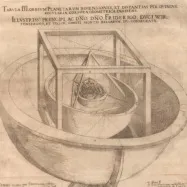
It was still wrong, and how Kepler found out is the point. Working through Tycho Brahe's observations, he calculated the orbit of Mars until he had to admit it was an ellipse, not a circle — the first two laws of planetary motion, in the Astronomia nova of 1609; the third followed in 1619. The nested solids explained nothing; the laws he found while trying to save them are the ones we still call Kepler's.
Sources University of St Andrews, MacTutor — mathshistory.st-andrews.ac.uk, "Johannes Kepler" · ETH-Bibliothek Zürich, Mysterium Cosmographicum (Tübingen, 1596) — archive.org · Luminet, Weeks, Riazuelo, Lehoucq and Uzan, Nature 425, 593–595 (9 October 2003) — nature.com · Observatoire de Paris — observatoiredeparis.psl.eu, "The Poincaré Dodecahedral Space model" · NASA — science.nasa.gov, "WMAP overview" · ARTOYA leaflet AV0118106
7Try this
Euclid's proof in card. Cut equilateral triangles, squares and regular pentagons. Tape three triangles around a point and lift the free edges until they meet; try four, five, six; then three and four squares; three and four pentagons. Notice: six triangles and four squares refuse to leave the table; four pentagons cannot even be laid down.
Count and check Euler. For each model, count vertices, edges and faces, ticking each edge on a sketch — edges are the ones people miscount. Notice: V − E + F is 2 five times, and the paired solids swap V and F.
Find the axes. Hold the icosahedron corner-up and turn it: it repeats every fifth of a turn. Face-up, every third; edge-up, every half. Notice: the dodecahedron has the same three; the hexahedron's face-up axis is four-fold, and no other model in the box has one.
Sources Euclid, Elements, Book XIII — Clark University, mathcs.clarku.edu · American Mathematical Society — ams.org, "Euler's Polyhedral Formula"
8Words to know
- Polyhedron — a solid with flat faces; plural polyhedra. The five are named by their face count in Greek: tetra- 4, hexa- 6, octa- 8, dodeca- 12, icosa- 20 — so the hexahedron is the cube.
- Regular solid — faces all the same regular polygon, corners all alike; five convex ones, the Platonic solids.
- Face, edge, vertex — the flat side, the line where two faces meet, the corner where edges meet.
- Convex — no dents or spikes; a line between any two points stays inside.
- Solid angle — the corner where several faces meet; Euclid's rule: its plane angles add up to less than 360°.
- Euler's formula — V − E + F = 2 for every convex polyhedron (letter to Goldbach, 1750).
- Dual — the partner solid made by joining face centres: hexahedron–octahedron, dodecahedron–icosahedron, tetrahedron–itself.
- Vacuum (Latin: emptied) — Pacioli's word for Leonardo's frame-only drawings; solidum is the closed version.
- Capsid — the protein shell of a virus, very often an icosahedron.
- Geodesic dome — a sphere-shaped roof of triangular facets sharing the load; Fuller's invention.
Sources Encyclopaedia Britannica — britannica.com, "Platonic solid", "virus: the protein capsid" and "geodesic dome" · American Mathematical Society — ams.org, "Euler's Polyhedral Formula" · Euclid, Elements, Book XIII — Clark University, mathcs.clarku.edu
9Sources
- Encyclopaedia Britannica — "Platonic solid": https://www.britannica.com/topic/Platonic-solid
- Encyclopaedia Britannica — "Euclid": https://www.britannica.com/biography/Euclid-Greek-mathematician
- Encyclopaedia Britannica — "Dungeons & Dragons": https://www.britannica.com/topic/Dungeons-and-Dragons
- Encyclopaedia Britannica — "methane": https://www.britannica.com/science/methane
- Encyclopaedia Britannica — "halide mineral": https://www.britannica.com/science/halide-mineral
- Encyclopaedia Britannica — "isometric system": https://www.britannica.com/science/isometric-system
- Encyclopaedia Britannica — "virus: The protein capsid": https://www.britannica.com/science/virus/The-protein-capsid
- Encyclopaedia Britannica — "radiolarian": https://www.britannica.com/science/radiolarian
- Encyclopaedia Britannica — "geodesic dome": https://www.britannica.com/technology/geodesic-dome
- Encyclopaedia Britannica — "R. Buckminster Fuller": https://www.britannica.com/biography/R-Buckminster-Fuller
- Stanford Encyclopedia of Philosophy — "Plato's Timaeus": https://plato.stanford.edu/entries/plato-timaeus/
- Euclid, Elements, Book XIII, Proposition 18 and the concluding remark — D. E. Joyce, Clark University: https://mathcs.clarku.edu/~djoyce/java/elements/bookXIII/propXIII18.html
- American Mathematical Society — Feature Column, "Euler's Polyhedral Formula": https://www.ams.org/publicoutreach/feature-column/fcarc-eulers-formula
- University of St Andrews, MacTutor History of Mathematics — "Johannes Kepler": https://mathshistory.st-andrews.ac.uk/Biographies/Kepler/
- Smithsonian Libraries and Archives — Euclid, Preclarissimus liber elementorum, Ratdolt, Venice, 25 May 1482 (Internet Archive): https://archive.org/details/preclarissimusl00eucl
- The Metropolitan Museum of Art — Twenty-sided die (icosahedron) with faces inscribed with Greek letters, 10.130.1158: https://www.metmuseum.org/art/collection/search/551072
- The Metropolitan Museum of Art — Faience polyhedron inscribed with letters of the Greek alphabet, 37.11.3: https://www.metmuseum.org/art/collection/search/253530
- Biblioteca Ambrosiana, Milan — "De divina proportione": https://ambrosiana.it/en/opere/de-divina-proportione
- The Metropolitan Museum of Art — Pacioli, Divina proportione, Venice, 1 June 1509, 19.50: https://www.metmuseum.org/art/collection/search/336656
- Biblioteca de la Universidad de Sevilla — Pacioli, Diuina proportione, Venice, 1509 (Internet Archive): https://archive.org/details/ARes12207
- The Metropolitan Museum of Art — Studiolo from the Ducal Palace in Gubbio, ca. 1478–82, 39.153: https://www.metmuseum.org/art/collection/search/198556
- Lincolnshire County Council — "Mysterious Roman dodecahedron found in Norton Disney to go on display": https://www.lincolnshire.gov.uk/news/article/1853/mysterious-roman-dodecahedron-found-in-norton-disney-to-go-on-display-in-lincolnshire-for-the-first-time
- The British Museum — copper-alloy dodecahedron from Fishguard, 1924,0411.1: https://www.britishmuseum.org/collection/object/H_1924-0411-1
- Gemological Institute of America — "Diamond description": https://www.gia.edu/diamond-description
- CDC Public Health Image Library — adenovirus-2 virions, 1974, ID 14768: https://wwwn.cdc.gov/phil/Details.aspx?pid=14768
- Ernst Haeckel — Kunstformen der Natur, 1904 (Biodiversity Heritage Library): https://www.biodiversitylibrary.org/item/104650
- The Canadian Encyclopedia (Historica Canada) — "Montreal Biosphere", T. C. Noakes, 2021: https://www.thecanadianencyclopedia.ca/en/article/montreal-biosphere
- ETH-Bibliothek Zürich — Kepler, Mysterium Cosmographicum, Tübingen, 1596 (Internet Archive): https://archive.org/details/1596-kepler-prodromus-dissertationum-cosmographicarum-continens-mysterium-cosmographicum
- J.-P. Luminet, J. R. Weeks, A. Riazuelo, R. Lehoucq and J.-P. Uzan — "Dodecahedral space topology as an explanation for weak wide-angle temperature correlations in the cosmic microwave background", Nature 425, 593–595 (9 October 2003): https://www.nature.com/articles/nature01944
- Observatoire de Paris – PSL — "The Poincaré Dodecahedral Space model gains support": https://observatoiredeparis.psl.eu/the-poincare-dodecahedral-space-model-gains.html
- NASA Science — "WMAP overview" (nine-year all-sky map, credit NASA / WMAP Science Team): https://science.nasa.gov/mission/wmap/wmap-overview/
- ARTOYA leaflet AV0118106 (EN copy as printed 21 Sep 2026) and its printed sources: Plato, Timaeus; Britannica; Euclid, Elements XIII; MAA Convergence; Pacioli, De divina proportione (1509); Kepler, Mysterium Cosmographicum (1596); Raphael, The School of Athens; The Met 39.153; The Nobel Prize, Chemistry 1996; Haeckel, Report on the Radiolaria (1887); Royal Society of Chemistry; Smithsonian NMNH; PNAS.
ARTOYA Education Platform · artoya.co/da-vinci-solids-5-piece-set · Download the leaflet and the lesson plan at myartventure.com/a/AV0118106 · [email protected]