The Ornithopter: how a turning handle becomes a wingbeat
Turn the crank and both wings beat on their cables. Nothing lifts; nothing was ever meant to. What you are holding is the question Leonardo asked for twenty years — can a person's muscles drive a pair of wings? — built in birch plywood, with the answer that finally came in 2010.
Build the ARTOYA Ornithopter and you build Leonardo's test rig: a crank, a gear train and two wings on cables. From there we follow his notebooks to Turin and Washington, into a bird's shoulder, a bat's hand, and the Snowbird of 2010.
« Having seen it is not as good as knowing it; knowing it is not as good as doing it. » — Xunzi, 3rd century BC
1What you are building
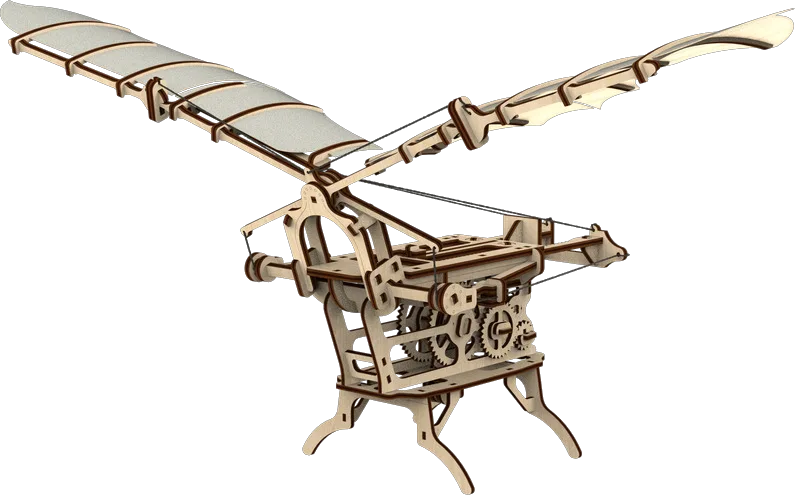
The ARTOYA Ornithopter is a 179-piece model in birch plywood, cut and marked on its boards. It is an advanced build of about two hours, in the order printed on the sheets in the box: check that every piece is on the board; press out each one only when the sheet calls for it; build the base and the gear train, and make sure the crank turns freely; fit both wings on the mast, then rig the cables that lift them; and paint last, once it stands, or keep it plain. Once built, it stays built.
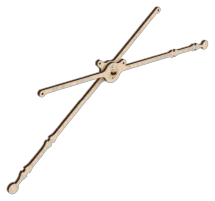
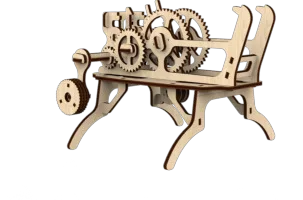
Let's be honest about what it is not. It will not fly, and nothing lifts it. A crank turns the gears; the wings beat on their cables at hand speed. It shows how a turning handle becomes a flapping stroke — the motion Leonardo drew, not the force he never found. It is built to be understood. What it gives in return: how turning becomes flapping, with crank, gears and cables in plain view; why a bird can do what a person cannot; and the point where a 500-year-old drawing meets a flight of 2010. Age 14+, and no two finished models are alike.
Sources ARTOYA leaflet AV0118202 (approved copy) and the AV0118202 instruction sheets, AUG2026 · Encyclopaedia Britannica — britannica.com, "ornithopter"
2From crank to wingbeat
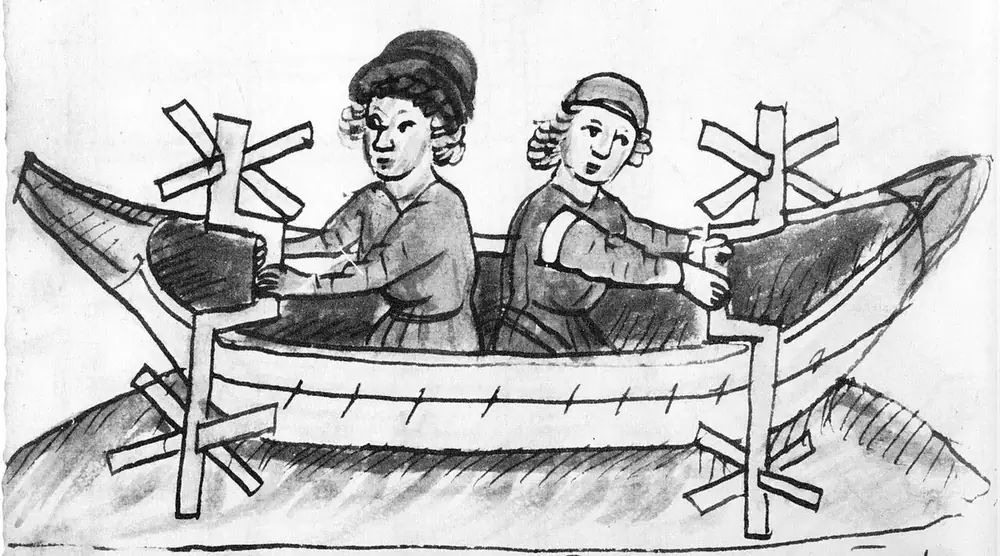
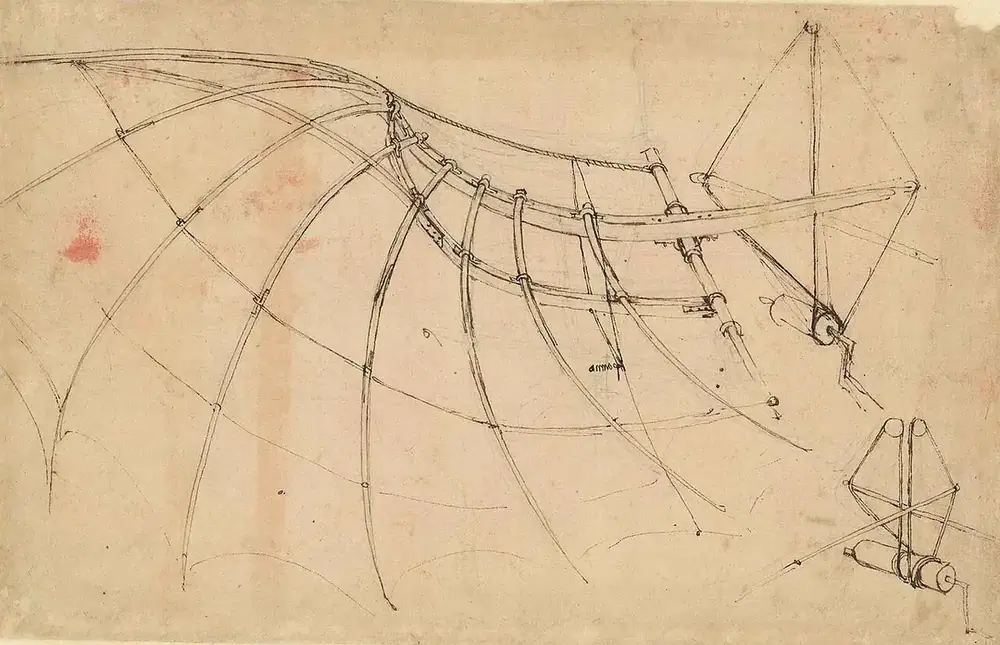
Start with the handle. A crank, Britannica says, "provides means for converting linear to rotary motion, and vice versa", and it was new in Leonardo's day — the crank with a connecting rod arrived around 1430, a generation before he was born. In our model it lives in the stand. Turn it and a train of gears carries the motion to two drive cables; the cables run into the machine, where a rack and pinion rock the wing spars on the mast. Round and round at the handle becomes up and down at the wingtip. That is the lesson of Leonardo's earliest flying-machine sheet, Codex Atlanticus f. 858r, about 1478–80, in the Biblioteca Ambrosiana in Milan, Italy — in the library's words, "a mechanical wing activated by a winch". The crank turns a drum, the rope pulls the wing; our cables do the same job.
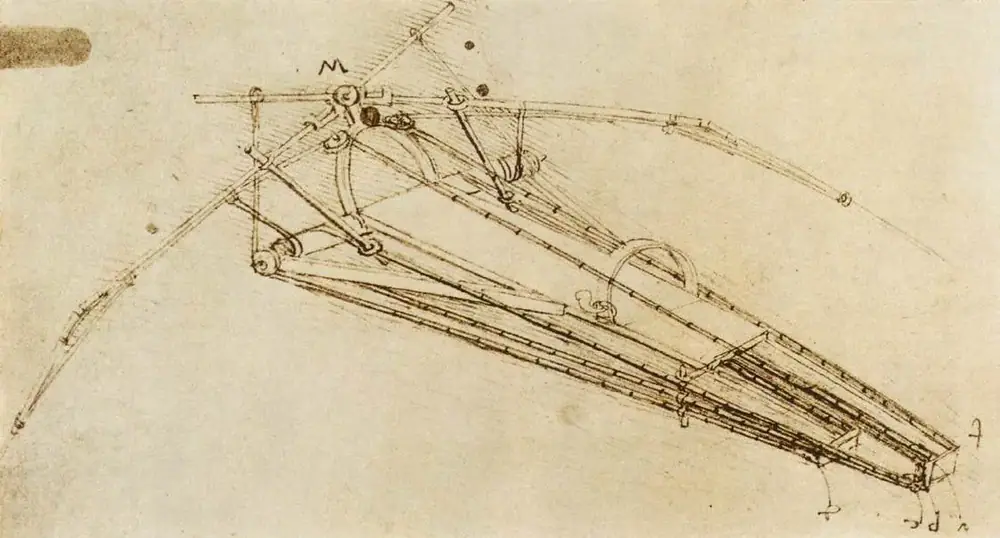
By 1487–90 he had gone further. Manuscript B, at the Institut de France in Paris, France, holds several whole flying craft. On f. 74v the pilot stands strapped on a platform and drives the wings with his feet in stirrups, through cords and pulleys; the wings turn edge-on as they rise and flat as they fall, with springs to bring them back.
Look at your model. Follow the motion from the handle: crank, gears, cable, rack, spar, wing. Each stage changes the direction of the motion or its size, and none adds energy. Leonardo's first sheet shows the same chain without the gears; the gears are ours, so that one turn drives both wings.
Sources Encyclopaedia Britannica — britannica.com, "crank" · Veneranda Biblioteca Ambrosiana — ambrosiana.it, "Codex Atlanticus, f. 858 recto" · Museo Galileo — brunelleschi.imss.fi.it, "Leonardo da Vinci — Ms. B" · Museo Leonardiano di Vinci — museoleonardiano.it, "Flying machine" (1938 model after Ms B f. 74v) · ARTOYA instruction sheets AV0118202
3Twenty years of flying machines
Leonardo drew flying machines for some twenty years and, as far as anyone knows, built none. The National Air and Space Museum in Washington, United States, counts more than 35,000 words and 500 sketches on flying machines, the nature of air and the flight of birds. He did plan a test: around 1493–95, on Codex Atlanticus f. 1006v, he meant to try a machine from the roof of his house in Milan, Italy, where the cathedral builders could not see — and no record says it happened.
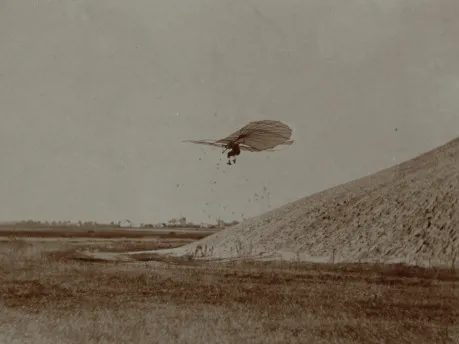
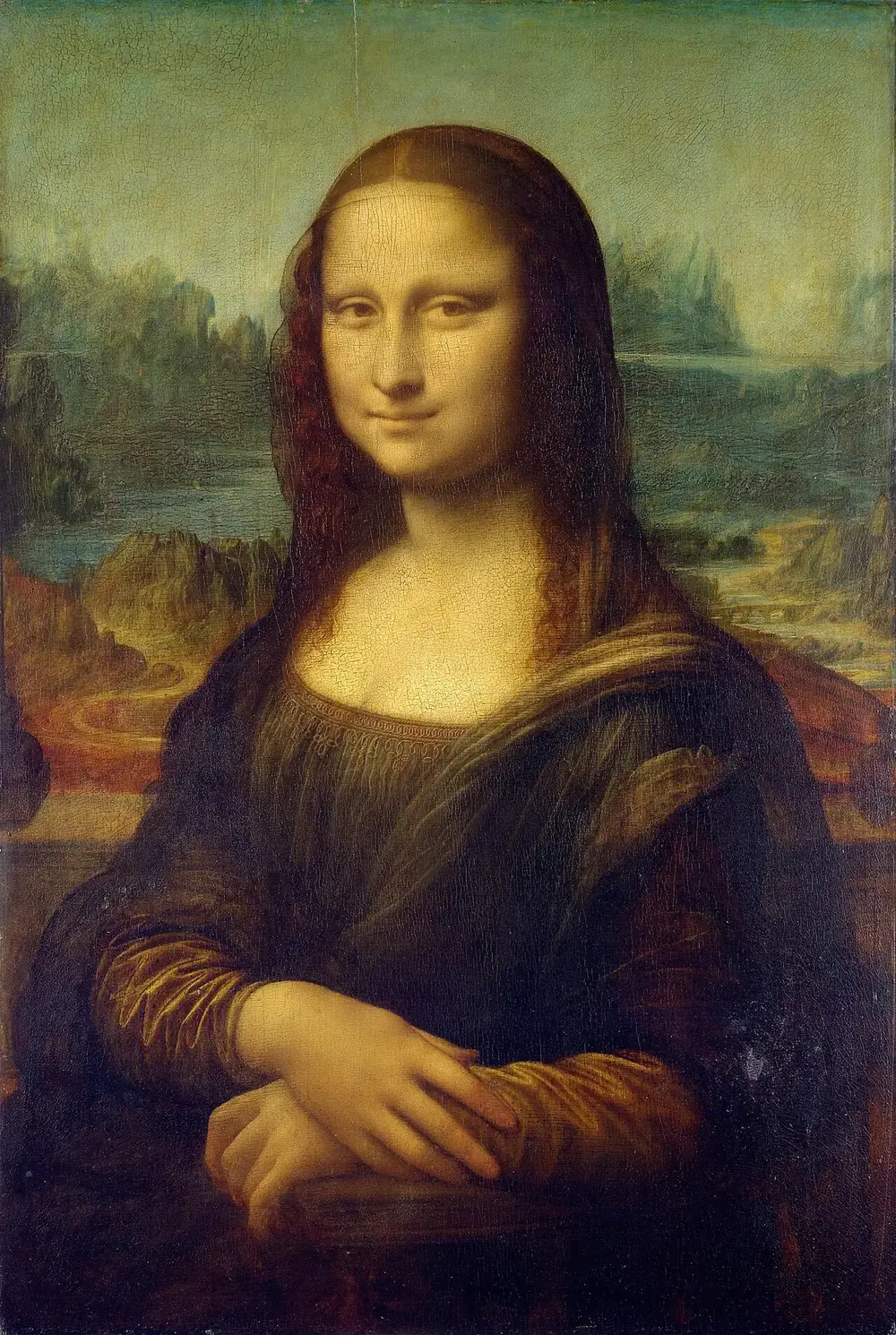
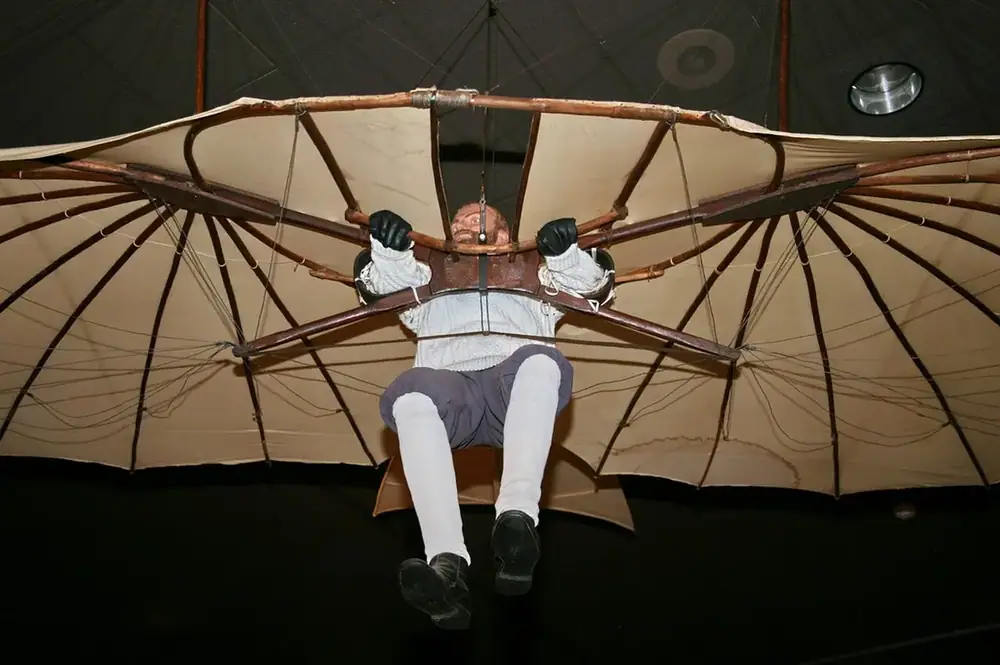
The last chapter is the Codex on the Flight of Birds, 1505–06: eighteen folios in his mirror script, written in the same years as the Mona Lisa, in which the machines give way to the birds — how a wing beats, how a bird balances, steers, dives and climbs, and how a pilot might steer by shifting his own weight, as the glider pioneers would do four centuries later. Otto Lilienthal was one of them: close to 2,000 glides on bird-shaped wings, 1891–96, and proof that a person could fly — by gliding, not flapping. As for the machine in Vinci, Italy, built after Manuscript B: it was made in 1938, in walnut, leather and rope, by an aeronautical school at Guidonia — 35 cm high and 87 cm long, on a museum shelf, not a hillside.
Sources Smithsonian National Air and Space Museum — airandspace.si.edu, "Leonardo da Vinci and Flight" (P. Jakab, 22 Aug 2013) and "Lilienthal Glider" A19060001000 · Library of Congress, World Digital Library — loc.gov, "Codex on the Flight of Birds" · Museo Galileo, leonardo//thek@ — teche.museogalileo.it, Codex Atlanticus f. 1006v · Museo Leonardiano di Vinci — museoleonardiano.it, "Flying machine", inv. OA 00000005
4Why a bird can and a person cannot
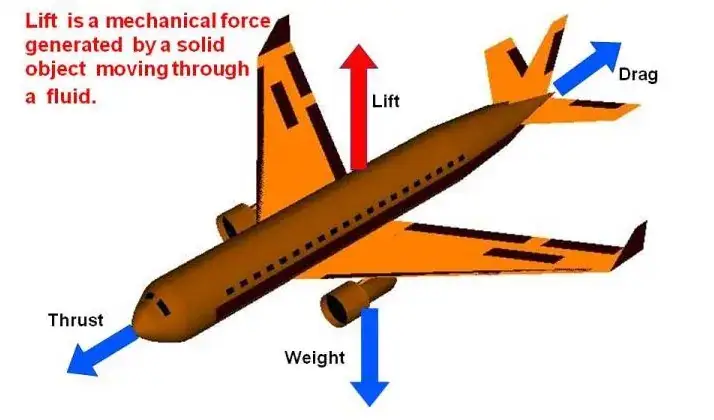
Lift first. NASA's Glenn Research Center gives the rule in one line: the air moving past a wing "is deflected downward by the shape and the motion of the wing. The wing exerts a force, or action, on the air and in re-action the wing is pushed upward by the air" — Newton's third law. Two things follow, and NASA states both: no fluid, no lift; no motion, no lift. A wing standing still in a room lifts nothing — the physics behind the honest line on our leaflet, and why Leonardo's machines had to flap.
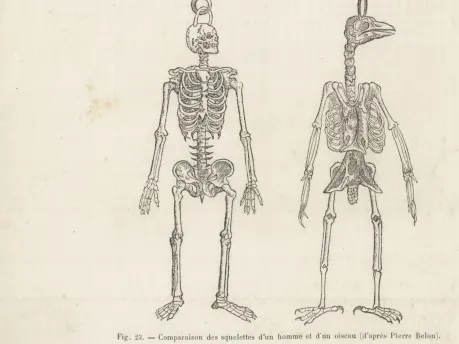
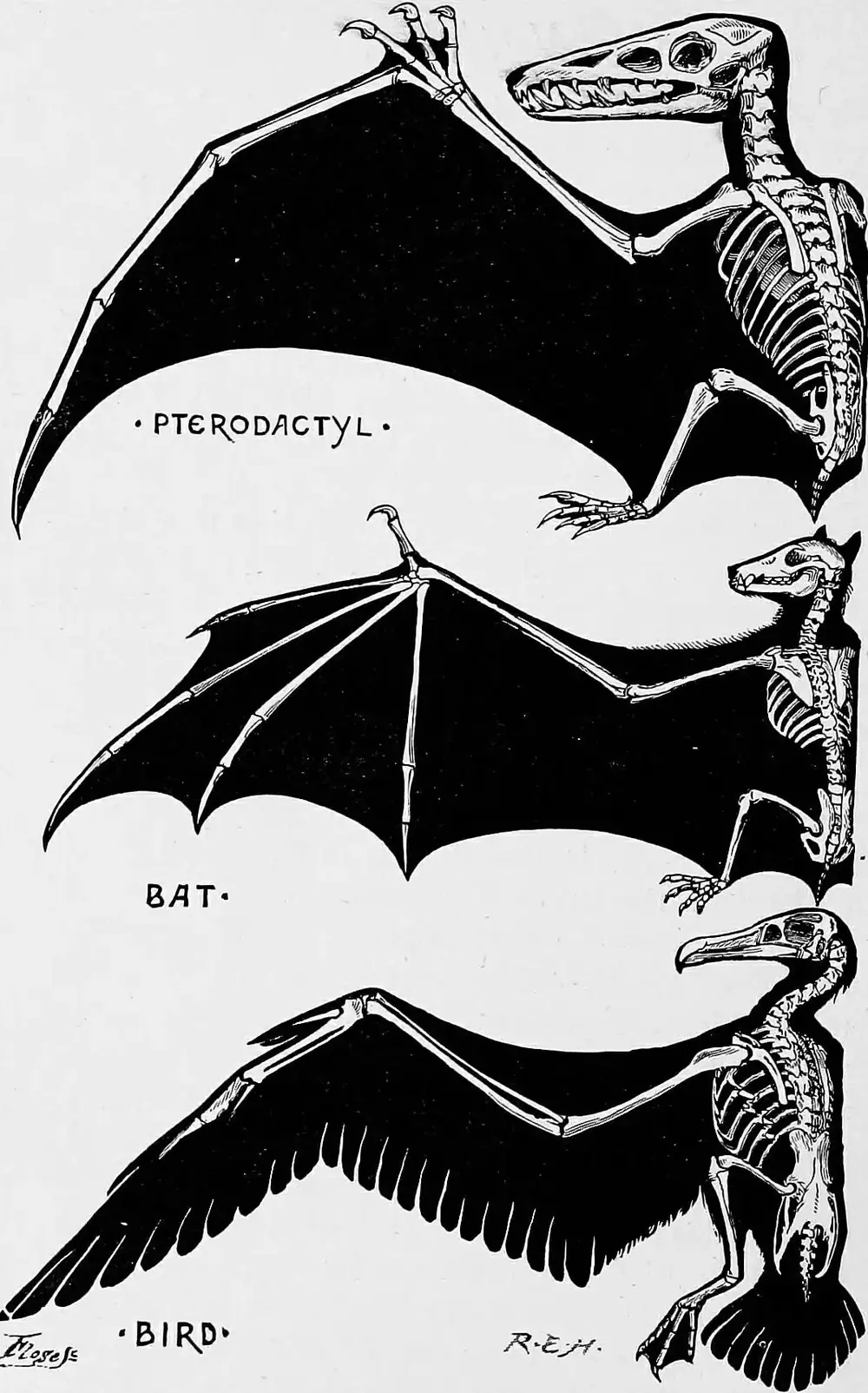
Now the bird. A bird's wing is an arm — humerus, radius, ulna, wrist, hand and fingers under the same names as ours, Arizona State University's biologists point out, "modified to have different functions". The bones are hollow, with air pockets rather than one open pipe, yet the bone itself is denser than a rodent's: light and strong is the trick. At the shoulder the differences begin: a deep keel on the breastbone, and flight muscles to match. Britannica adds what Leonardo could not see: "a bird's wing acts as both wing and propeller. The basal part of the wing supplies most of the supporting surface, the wing tip most of the propelling force." The downstroke gives lift and thrust at once — what Leonardo tried to copy with cranks and cables.
And the person. Power to weight is the wall: a person makes little power for the weight to lift. Snowbird, the first human-powered ornithopter to sustain flight, needed 32 m of wing to carry 42 kg, and its pilot was also its engine. A bird carries its power plant in its chest; we carry ours in our legs, a long way from the wing — "the demonstrably limited muscle power and endurance of humans compared to birds", as the Smithsonian puts it.
Sources NASA Glenn Research Center, Beginner's Guide to Aeronautics — www1.grc.nasa.gov, "What is Lift?" and "Newton's Third Law, Action and Reaction" · Arizona State University, Ask A Biologist — askabiologist.asu.edu, "Human, Bird, and Bat Bone Comparison" · University of California Museum of Paleontology — ucmp.berkeley.edu, "Aves: More on Morphology" · Encyclopaedia Britannica — britannica.com, "bird: Flight" · Smithsonian National Air and Space Museum — airandspace.si.edu, "Leonardo da Vinci and Flight" · University of Toronto — utoronto.ca, "World record human-powered flight confirmed"
5Bodies in motion
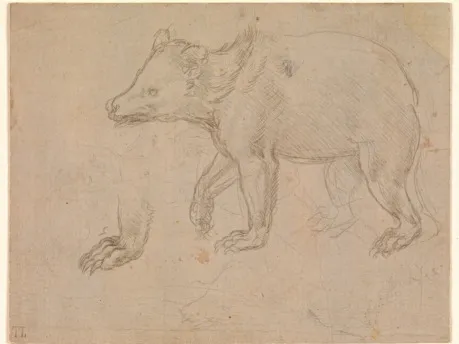
Leonardo studied bodies in motion before he drew machines to move. A Bear Walking, a silverpoint of about 1482–85 in the Metropolitan Museum of Art in New York, United States, follows the animal mid-step, with a separate study of its paw. The Met puts the little sheet — 10.3 by 13.3 centimetres — among bear studies for an anatomical treatise he never finished, probably drawn from life. Look closely and the paper has been used twice: beneath the bear are the faint outlines of a seated woman.
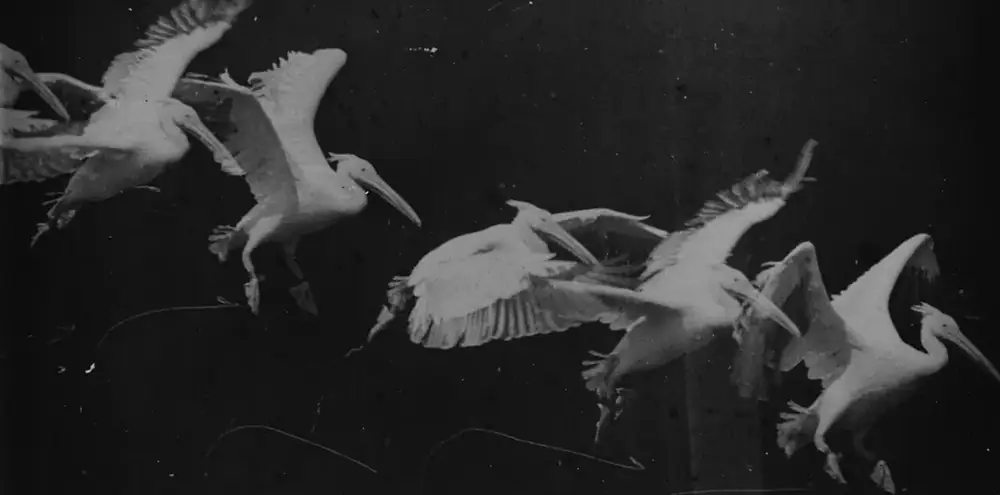
The same eye later filled the Codex on the Flight of Birds with wings turning in the wind. The method was comparison: a paw, a wing and a lever obeyed one set of rules, and drawing was how he found them. Three centuries on, the physiologist Étienne-Jules Marey did the same in Paris, France, with a camera; his Le vol des oiseaux of 1890 sets a man's skeleton beside a bird's, after Pierre Belon's bird book of 1555.
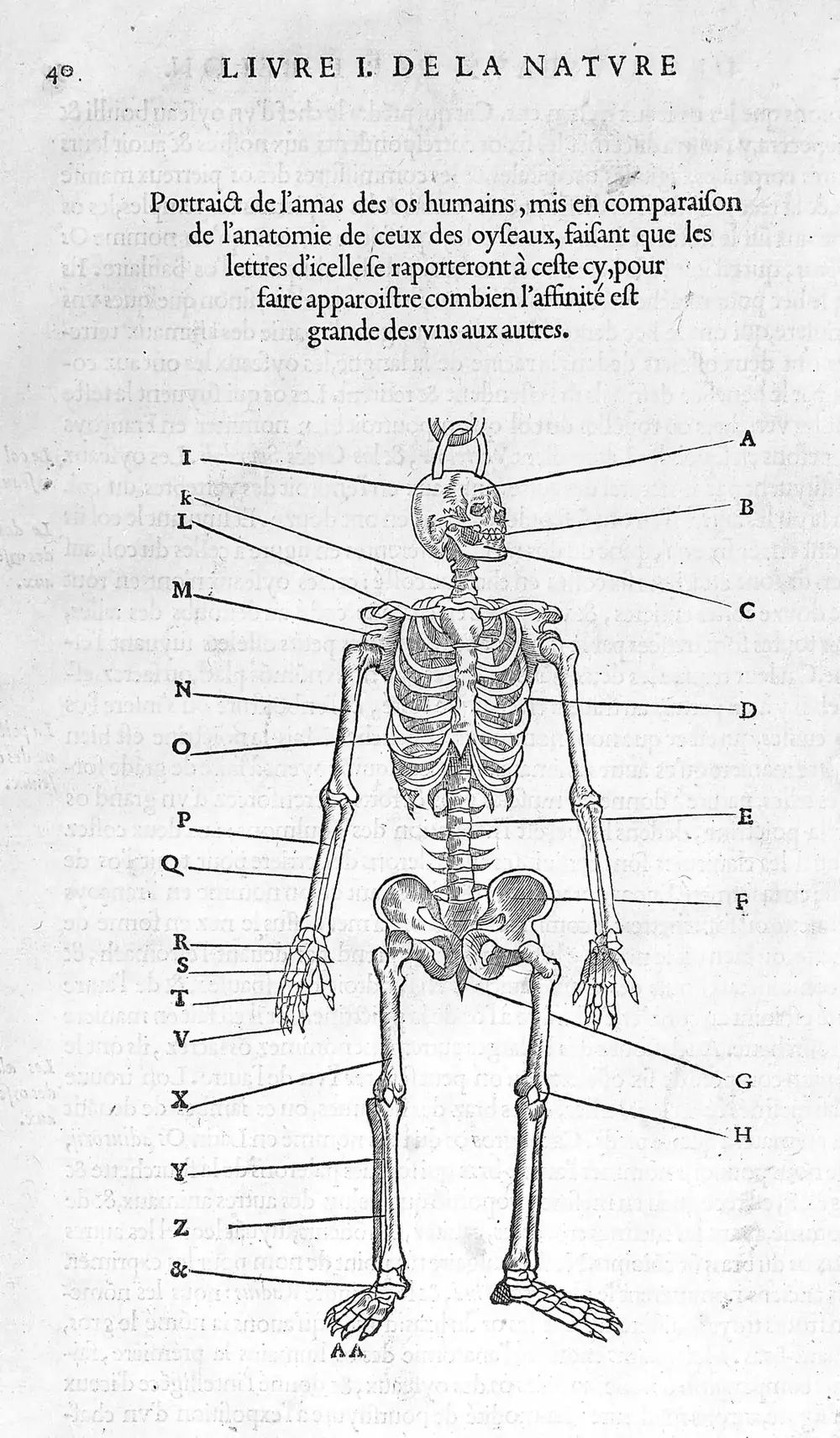
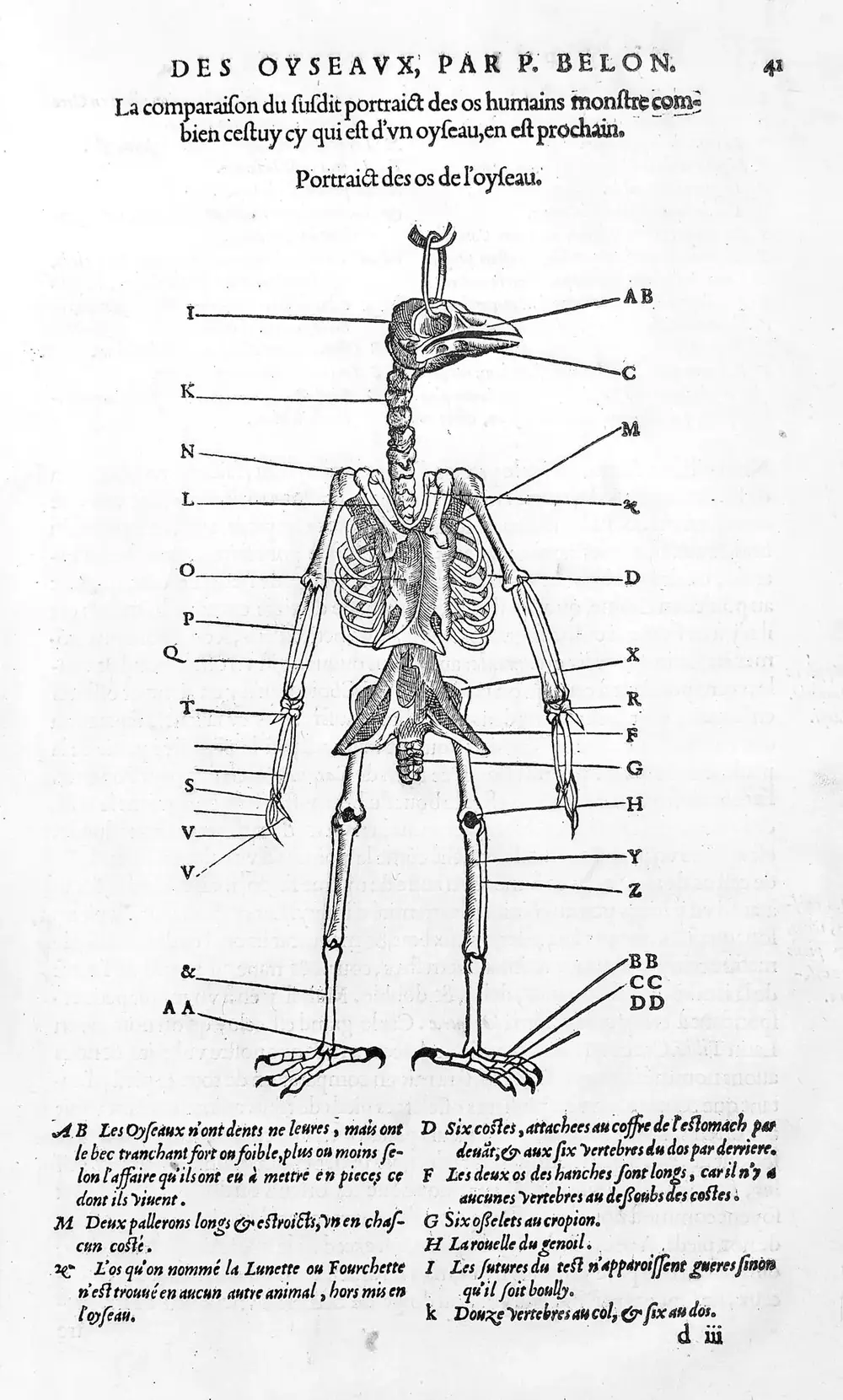
Sources The Metropolitan Museum of Art — metmuseum.org, "A Bear Walking", Robert Lehman Collection, 1975.1.369 · Wellcome Collection — wellcomecollection.org, "The skeleton of a man for comparison with that of a bird, 1555" and "The skeleton of a bird for comparison with that of a man, 1555" · Internet Archive / Getty Research Institute — archive.org, É.-J. Marey, "Physiologie du mouvement: le vol des oiseaux", 1890
6Light, and learning from birds
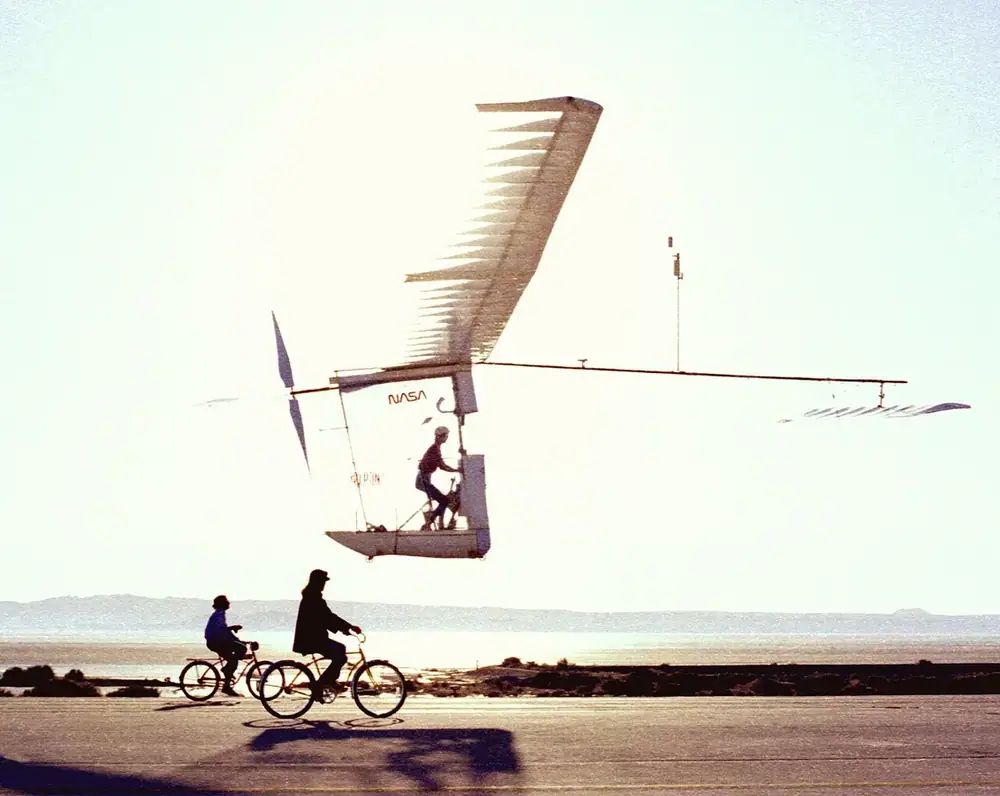
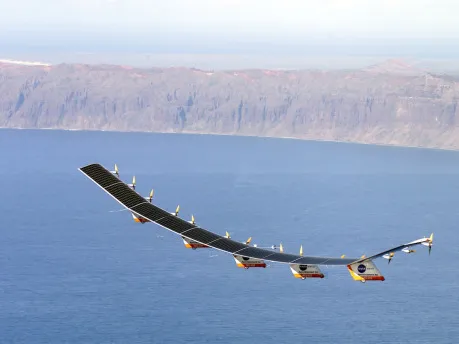
Flapping never became the way we fly, but Leonardo's other lesson did: build light and learn from birds. On 12 June 1979 the pedal-driven Gossamer Albatross, 31.8 kg empty on a wingspan of 28.6 m, crossed the English Channel from Folkestone, England, to Cap Gris-Nez, France — 36.2 km in 2 h 49 min, with Bryan Allen pedalling. It was mostly carbon-fibre tubing under clear Mylar, designed by Paul MacCready's team. In 2001 the same makers' solar wing Helios, 75 m across and arched like a soaring bird, climbed to 29,524 m, a record for level flight by a winged aircraft. Engineers call this borrowing biomimicry.
The flapping dream had one more chapter. On 2 August 2010 the Snowbird, a human-powered ornithopter, flapped for 19.3 seconds and 145 metres over Ontario, Canada — the first ever to sustain flight. Two graduate students of the University of Toronto Institute for Aerospace Studies, Todd Reichert and Cameron Robertson, built it, and the Fédération Aéronautique Internationale confirmed the record on 27 November 2012. Reichert was pilot and engine.
Sources Smithsonian National Air and Space Museum — airandspace.si.edu, "MacCready Gossamer Albatross" A19810428000 · NASA Armstrong (Dryden) Flight Research Center — nasa.gov, fact sheet FS-054 "Gossamer Penguin" and FS-068 "Helios Prototype" · University of Toronto — utoronto.ca, "World record human-powered flight confirmed"
7Try this
Count the stages. Turn the crank slowly and put a finger on each part as the motion passes through it: handle, gear, cable, rack, spar, wing. Then turn the handle one full revolution and count the wingbeats. What to notice: how many turns make one beat, and which stage does the changing.
Find the arm in a wing. Take a roast chicken wing before it is carved, or a photograph of a bird or bat skeleton, and find the three sections: upper arm, forearm, hand. What to notice: the joints bend the way yours do, and the hand is where the flight feathers grow — or, on a bat, where the skin is stretched — the propeller end, in Britannica's words.
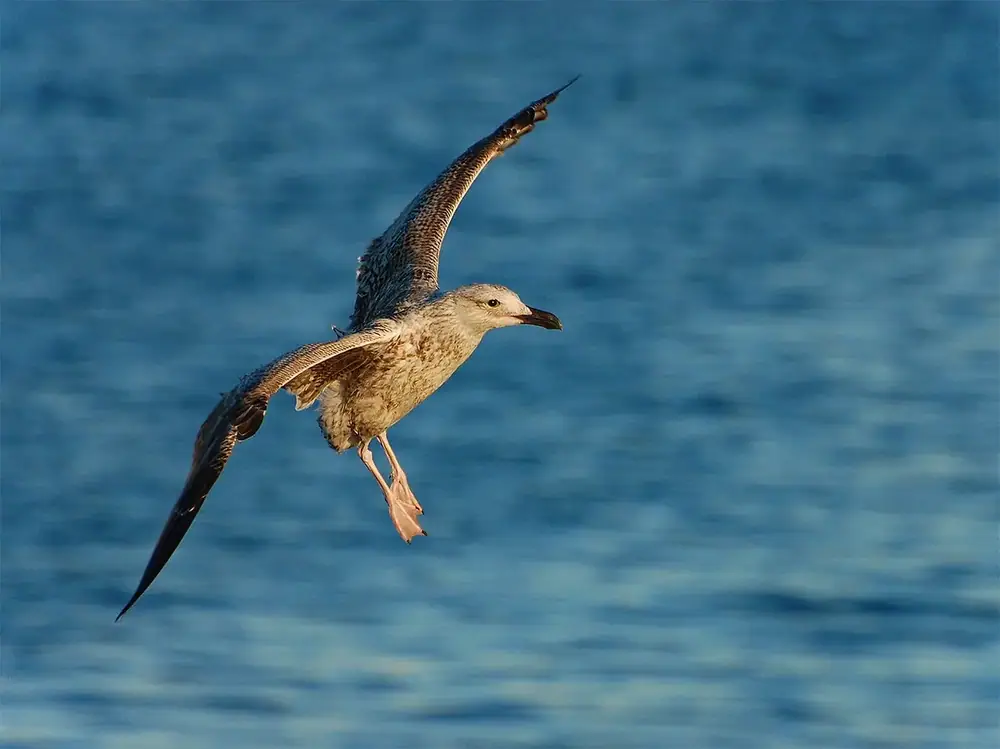
Watch a bird land. Pick a pigeon or a gull coming in to a railing and watch only the last second. What to notice: the wings tilt to face the air, beat forward and cup — the wing that carries the bird is now its brake. That is what the Codex on the Flight of Birds is full of, and what no crank can copy.
Sources ARTOYA instruction sheets AV0118202 · Arizona State University, Ask A Biologist — askabiologist.asu.edu · Encyclopaedia Britannica — britannica.com, "bird: Flight" · Smithsonian National Air and Space Museum — airandspace.si.edu, "Leonardo da Vinci and Flight"
8Words to know
- Ornithopter — an aircraft meant to fly by flapping its wings; from the Greek for bird and wing, on the pattern of helicopter; first recorded in English in 1908.
- Crank — an arm set at a right angle to a shaft, used to turn straight-line motion into rotation and back again.
- Rack and pinion — a toothed bar and a small gear; turning the gear moves the bar in a straight line, which in this model rocks the wing spars.
- Lift — the force that holds a wing up, produced when the moving wing turns the air downward; Newton's third law at work.
- Keel — the ridge on a bird's breastbone where the big flight muscles attach.
- Membrane wing — a flight surface of skin stretched over long finger bones, as in bats and pterosaurs; the cloth on Leonardo's frames copied it.
- Power-to-weight ratio — how much power a flier produces for each kilogram it must lift; the reason a sparrow can flap and a person cannot.
- Biomimicry — borrowing a design from nature, as a light, arched wing borrows from a soaring bird.
Sources Merriam-Webster — merriam-webster.com, "ornithopter" · Encyclopaedia Britannica — britannica.com, "crank" and "ornithopter" · NASA Glenn Research Center — www1.grc.nasa.gov, "What is Lift?" · University of California Museum of Paleontology — ucmp.berkeley.edu · Arizona State University, Ask A Biologist — askabiologist.asu.edu
9Sources
- Veneranda Biblioteca Ambrosiana — Codex Atlanticus, f. 858 recto (c. 1478–80): https://ambrosiana.it/en/opere/atlantic-codex-codex-atlanticus-f-858-recto
- Museo Galileo — leonardo//thek@ (Codex Atlanticus ff. 858r, 824v, 1006v): https://teche.museogalileo.it/leonardo/intro/index_en.html?lang=en
- Museo Galileo — "Leonardo da Vinci — Ms. B" (Institut de France, c. 1487–90): https://brunelleschi.imss.fi.it/genscheda.asp?appl=LIR&xsl=manoscritto&lingua=ENG&chiave=100779
- Museo Leonardiano di Vinci — "Flying machine" (model after Ms B f. 74v; Scuola di Costruzioni ed Esperienze Aeronautiche di Guidonia, 1938; walnut, leather, cotton rope, iron; H 35 cm, L 87 cm; inv. OA 00000005): https://museoleonardiano.it/en/opera/flying-machine/
- Museo Leonardiano di Vinci — "Study of a beating wing" (model, 1929; the bat-membrane covering): https://museoleonardiano.it/en/opera/study-of-a-beating-wing/
- Smithsonian National Air and Space Museum — "Leonardo da Vinci's Codex on the Flight of Birds" (exhibition, 13 Sep–22 Oct 2013, Wright Brothers gallery): https://airandspace.si.edu/exhibitions/leonardo-da-vincis-codex-flight-birds
- Smithsonian National Air and Space Museum — Peter Jakab, "Leonardo da Vinci and Flight", 22 Aug 2013: https://airandspace.si.edu/stories/editorial/leonardo-da-vinci-and-flight
- Smithsonian National Air and Space Museum — Peter Jakab, "An Extraordinary Journey: The History of Leonardo da Vinci's Codex on the Flight of Birds", 13 Sep 2013: https://airandspace.si.edu/stories/editorial/extraordinary-journey-history-leonardo-da-vincis-codex-flight-birds
- Smithsonian National Air and Space Museum — "Lilienthal Glider", A19060001000: https://airandspace.si.edu/collection-objects/lilienthal-glider/nasm_A19060001000
- Smithsonian National Air and Space Museum — "MacCready Gossamer Albatross", A19810428000: https://airandspace.si.edu/collection-objects/maccready-gossamer-albatross/nasm_A19810428000
- Library of Congress, World Digital Library — "Codex on the Flight of Birds", Royal Library of Turin: https://www.loc.gov/item/2021668201/
- Natural History Museum, London — "What is the biggest bird in the world?" (wandering albatross: 2.5–3.5 m average, 3.63 m record; 120,000 km a year): https://www.nhm.ac.uk/discover/what-is-the-biggest-bird-in-the-world.html
- Natural History Museum, London — James Ashworth, "The largest-ever flying animal behaved like a giant heron", 15 Dec 2021 (Quetzalcoatlus northropi: c. 11 m wingspan, Big Bend, named 1975, 67 million years, 2.5 m jump): https://www.nhm.ac.uk/discover/news/2021/december/largest-ever-flying-animal-behaved-like-giant-heron.html
- NASA Glenn Research Center, Beginner's Guide to Aeronautics — "What is Lift?": https://www1.grc.nasa.gov/beginners-guide-to-aeronautics/what-is-lift/
- NASA Glenn Research Center, Beginner's Guide to Aeronautics — "Newton's Third Law, Action and Reaction": https://www1.grc.nasa.gov/beginners-guide-to-aeronautics/newtons-third-law-action-reaction/
- NASA Armstrong (Dryden) Flight Research Center — fact sheet FS-054, "Gossamer Penguin": https://www.nasa.gov/wp-content/uploads/2021/09/120308main_fs-054-dfrc.pdf
- NASA Dryden Flight Research Center — fact sheet FS-068, "Helios Prototype" (as cited on the leaflet): nasa.gov
- University of Toronto — "World record human-powered flight confirmed" (27 November 2012): https://www.utoronto.ca/news/world-record-human-powered-flight-confirmed
- Ingenium — Canada Aviation and Space Museum, Ottawa — "Snowbird", UTIAS, 2006–2010, artifact 2012.0089.001 (project history, materials, leg-press drive, "the last great aviation first"): https://collection.ingenium.ca/en/id/2012.0089.001/
- Arizona State University, Ask A Biologist — "Human, Bird, and Bat Bone Comparison": https://askabiologist.asu.edu/human-bird-and-bat-bone-comparison
- University of California Museum of Paleontology — "Aves: More on Morphology": https://ucmp.berkeley.edu/diapsids/birds/birdmm.html
- Encyclopaedia Britannica — "bird: Flight": https://www.britannica.com/animal/bird-animal/Flight
- Encyclopaedia Britannica — "ornithopter": https://www.britannica.com/technology/ornithopter
- Encyclopaedia Britannica — "crank": https://www.britannica.com/technology/crank
- Merriam-Webster — "ornithopter": https://www.merriam-webster.com/dictionary/ornithopter
- The Metropolitan Museum of Art — Leonardo da Vinci, A Bear Walking, Robert Lehman Collection, 1975.1.369: https://www.metmuseum.org/art/collection/search/459184
- Wellcome Collection — "The skeleton of a man for comparison with that of a bird, 1555" (Belon): https://wellcomecollection.org/works/adx89v7j
- Wellcome Collection — "The skeleton of a bird for comparison with that of a man, 1555" (Belon): https://wellcomecollection.org/works/djbegghf
- Wellcome Collection — "Eight different specimen of bats shown with spread and folded wings. Coloured etching by S. Milne", 40816i: https://wellcomecollection.org/works/jx8frgqk
- Internet Archive / Getty Research Institute — É.-J. Marey, Physiologie du mouvement: le vol des oiseaux, Paris, 1890: https://archive.org/details/gri_33125008636926
- Wikimedia Commons — "Codice Volo 08R mod.jpg" (Biblioteca Reale di Torino scan, public domain): https://commons.wikimedia.org/wiki/File:Codice_Volo_08R_mod.jpg
- Wikimedia Commons — JJ Harrison, "Diomedea exulans in flight - SE Tasmania.jpg", 2012, CC BY-SA 3.0: https://commons.wikimedia.org/wiki/File:Diomedea_exulans_in_flight_-_SE_Tasmania.jpg
- Wikimedia Commons — Geekgecko, "Quetzalcoatlus in flight Perot.jpg", 2024, CC BY 4.0: https://commons.wikimedia.org/wiki/File:Quetzalcoatlus_in_flight_Perot.jpg
- Wikimedia Commons — Ahunt, "UTIAS Snowbird ornithopter 1198.JPG", 2014, CC0: https://commons.wikimedia.org/wiki/File:UTIAS_Snowbird_ornithopter_1198.JPG
- ARTOYA leaflet AV0118202 (approved EN copy, printed 21 Sep 2026) and its printed sources: Museo Galileo leonardo//thek@; Smithsonian NASM; NASA Glenn; Marey 1890; University of Toronto; The Met; NASA Dryden FS-068. ARTOYA instruction sheets AV0118202 (machine, 47 panels; stand, 55 panels), AUG2026.
ARTOYA Education Platform · artoya.co/da-vinci-ornithopter · Download the leaflet and the lesson plan at myartventure.com/a/AV0118202 · [email protected]